I must have sensed that more was involved in baseball than the accomplishments of a few athletes and teams, and that I was now attached in a rather mysterious way to a larger structure, to something deep and rooted, with its own history, customs, records, honored and dishonored warriors, founders, superstitions, and clouded lore. I belonged and I cared, and because I have been lucky enough to go on caring, I have belonged to baseball now for almost half its history. – Roger Angell (Late Innings, Ballantine Books, 1982).
A collection of personal essays, musings, and questions about life, history, politics, religion and baseball.
Thursday, March 15, 2012
Dispatches from Spring
Friday, March 9, 2012
Strat-O-Matic Memories: The Baseball Years
Statistics are the food of love. Baseball is nourished by numbers, and all of us who have followed the game with intensity have found ourselves transformed into walking memory banks, humming with games won, games lost, batting averages and earned-run averages, games started and games saved, "magic numbers," final standings, lifetime marks, Series, seasons, decades, epochs. -- Roger Angell
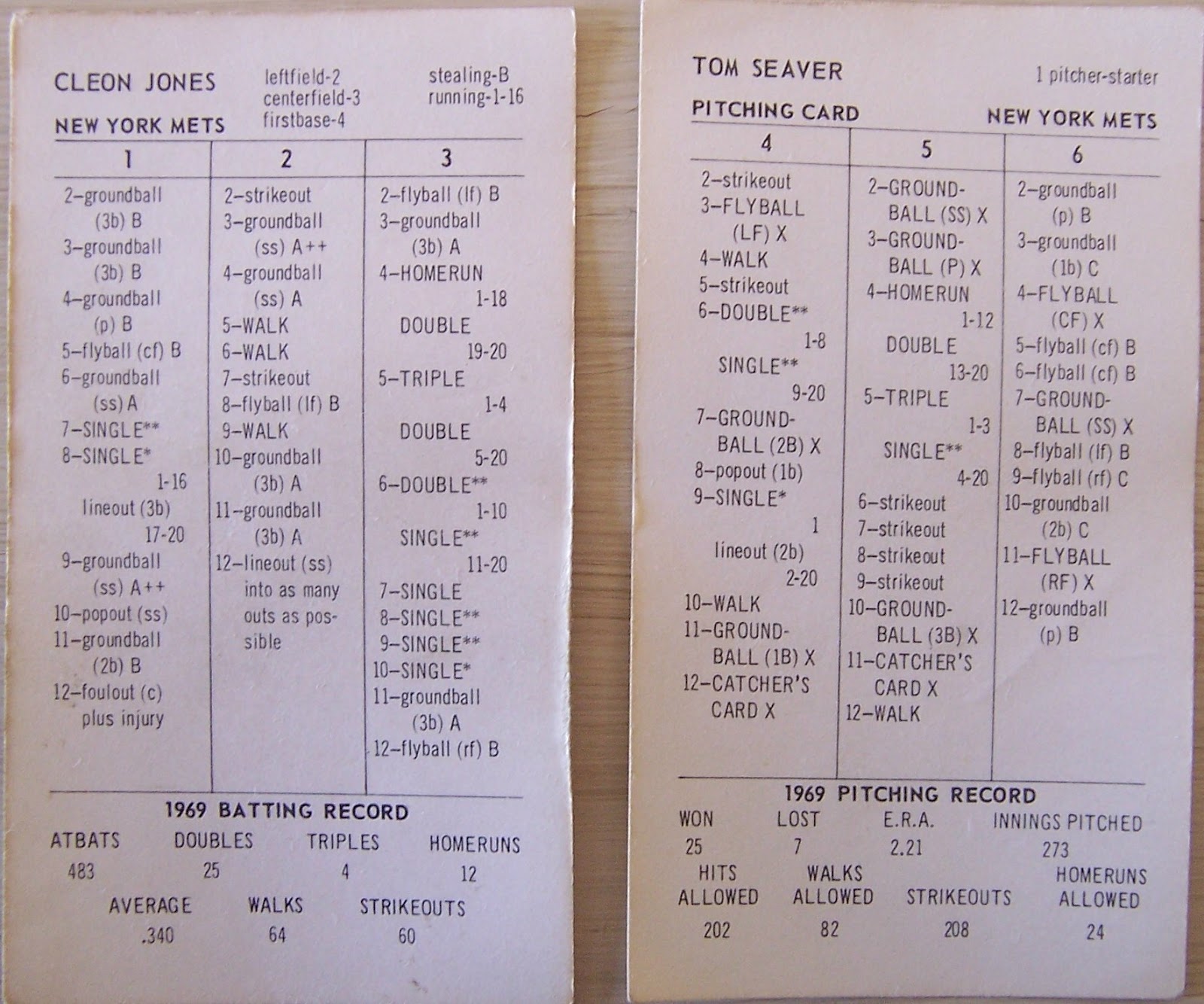
I still have all of my hand-kept statistics of my Strat-O-Matic seasons in the 1970’s. In looking them over recently, I was reminded that, in my first season, the Cardinals went 104-58, led by the spectacular pitching of Bob Gibson (25-5, 2.05) and Steve Carlton (21-10, 2.12) and the hitting of Joe Torre (22 HR, 102 RBI, .302), Lou Brock (.291, 107 R, 69 SB) and Curt Flood (.311, 40 doubles, 25 SB). Despite this quite impressive performance, we lost the first round of the playoffs in five games to the Cincinnati Reds, losing the fifth and final game in 16 innings by a score of 7-6, when Johnny Bench knocked in Lee May for the winning run. In looking over the box score from that game, I am forced to re-live the agonizingly painful frustration I felt as we lost in the bottom of the 16th, despite having taken a 6-5 lead in the top of that inning. Though my recollection fails me, I would not be surprised if some dice were thrown and profanities uttered, a not uncommon occurrence in Strat-O-Matic households.
Sunday, October 30, 2011
Of Destiny and Miracles
Until now, the Cardinals had never won a World Series with a team like this. A team that was lost, left behind and stranded in the standings. A team too proud and stubborn to accept the hopelessness of the situation. A team that fought back like no other has in franchise history. – Bernie Miklasz, St. Louis Post-Dispatch
Sunday, October 2, 2011
Still Believing in Miracles
I think it’s really good for baseball. It’s not so good for my stomach. – Terry Francona
Sunday, February 20, 2011
The End of Winter
Don't tell me about the world. Not today. It's springtime and they're knocking baseballs around fields where the grass is damp and green in the morning and the kids are trying to hit the curve ball. ~Pete Hamill
Tuesday, October 12, 2010
Almost Time to Rake the Leaves
Tuesday, July 13, 2010
Random Thoughts at the All-Star Break

· Has anyone figured out what the Russian spy scandal was actually about? From what I can tell, the closest thing to a state secret revealed was the new menu offering from Wendy’s.
· Does Nicholas Kristof have a point? The liberal New York Times columnist has been on a pro-Palestinian kick lately; a thoughtful one, offered with his typical humanitarian flair, but in this instance I worry he has lost balance and, as is often the case with perspectives on the Israeli-Palestinian dispute, a sense of recent history. I agree that the Israelis mishandled the Turkish flotilla raid that led to nine deaths, and they were right to ease the blockade of goods being imported into the Gaza strip, but the bad guys remain the leaders and members of Hamas. Until its leaders speak and act differently – acknowledge Israel’s right to exist and stop lobbing unprovoked missiles into the suburbs of Tel Aviv – I cannot generate much sympathy for them. It is unfortunate that the more reliable defender these days of the only democracy and glimmer of hope in the Middle East is not the liberal establishment but, rather, conservatives and evangelical Christians.
· Where is the outrage? Oil continues to spill into the Gulf of Mexico at alarming rates, killing fish and wildlife and upsetting ecosystems, disrupting the lives and destroying the livelihoods of tens of thousands of residents on the coasts of Louisiana, Mississippi, and Alabama. If the Deepwater Horizon disaster does not cause us to hesitate with further offshore drilling ventures, reconsider our energy policies, and recommit to green energy solutions, we are destined for a future of continued dependence on foreign oil, irreversible climate change, and economic troubles. As Gretel Ehrlich, writing for Sojourners, recently said: “We’ve forgotten that when we step down on the earth we are walking on a living membrane. Now we are wounded people recklessly pimping a wounded planet. We’ve turned away from a sacred view of the world, a deep openness in which we accept that all living things have value. We’ve drilled recklessly under the ocean floor for economic gain, and in the process exchanged a sense of well-being, beauty, hope, and wonder for the myopia of profit.”
· Is Rush Limbaugh serious, merely delusional, or a complete fraud? Limbaugh has repeatedly portrayed President Obama as an “angry black man” who is intentionally tanking the American economy in order to obtain “economic reparations” for minorities. Not only does this make no sense, it is so disingenuous that I find it impossible that the fat windbag actually believes most of the verbal trash he spews on the airwaves.
· Should we be worried? Chris Matthews warned last week that the Democrats should take Sarah Palin seriously, that she could actually make a credible run for the White House in 2012. Her unfavorable ratings still seem too high, in my opinion, for her to be a serious threat, and I do not believe she can withstand the intense media scrutiny that presidential elections impose. But Matthews knows a thing or two about American politics, so if he says she could win, it is a matter of concern for sane, rational Americans.
On Law:
· What’s in a lawsuit? The Department of Justice was correct to enjoin Arizona from enforcing its new immigration law. The doctrine of federal preemption renders the state law unconstitutional. This is a non-political, legally correct position that even the Bush administration would have had no choice but to assert as well. Federal immigration policy has national and foreign policy implications, it affects our relations with sovereign nations, international aid groups, and it requires substantial coordination of federal law enforcement resources. We cannot realistically have 50 different immigration policies scattered among the states, particularly when the federal government (Immigration and Customs Enforcement) is required to implement the deportations and detentions that would result from laws like that in Arizona. That said, it is long past time for Congress and the President to enact comprehensive immigration reform.
On Life:
· Is the United States in the midst of a tattoo epidemic? Or is it only Philadelphia? The many and varied forms of displayed body art that I observe on my walks through center city remind me of building graffiti and subway art, except that the tattoos are less aesthetically pleasing.
· Why did I join the private sector? A recent survey of the federal workforce showed that 8 in 10 federal employees like the work that they do, and more than 90% think that what they do is important. This is how I felt for the nearly 20 years I worked in government, when I possessed a heightened sense of self-worth and the feeling that what I did mattered, that I was contributing, if only in a small way, to an effective criminal justice system and a functioning Constitution. Oh, yeah, the money.
On the Cult of Celebrity:
· Why should we care about the fate of Lindsay Lohan? Don’t misunderstand, I feel sorry for her in the way I feel sorry for any anorexic, drugged out, over-partied, spoiled brat with a bad father, but do we really need to devote that much air and print time to such a trivial story? Is she not just one more of the hundreds of examples, from Judy Garland to Gary Coleman, of child stars being consumed, exploited, chopped up and discarded by a narcissistic Hollywood culture of breast implants, glorified drug use, money and superficial glitz?
· Speaking of role models, is Cleveland really such a bad place to live? I am not sure whose idea it was for LeBron James to waste sixty minutes of national television time announcing that he has chosen “South Beach” (not Miami mind you) in which to spend the next several years of his NBA career, but he could have more easily and tactfully humiliated the fans of Cleveland with a press release.
I believe there ought to be a constitutional amendment outlawing Astroturf and the designated hitter. --Crash Davis in “Bull Durham”As with changes to baseball’s grand traditions, social and political progress often advances gradually and in small increments. Just as with the elimination of artificial surfaces in most major league ballparks, Don’t Ask, Don’t Tell will eventually be repealed and John Edwards’ ego will eventually deflate. So, as you continue on your life’s journey, remember always the immortal words of former Yankees manager Bob Lemon, “The two most important things in life are good friends and a strong bullpen.”
Sunday, June 6, 2010
A Lesson in Grace, Forgiveness, and the Imperfections of Man

The true perfection of man lies not in what man has, but in what man is.
--Oscar Wilde
James Joyce, the famous author, once wrote, “A man’s errors are his portals of discovery.” Jim Joyce, the first-base umpire who blew the call that should have been the 27th and final out in the ninth inning, recognized his namesake’s wisdom the hard way. Joyce (the umpire) ruled that Jason Donald of the Indians beat out a ground ball that had been hit between the first and second baseman. The replay clearly showed that Donald was out – by nearly two feet – after Tigers’ first baseman Miguel Cabrera fielded the ball and threw to Galarraga covering first. Galarraga and Cabrera clenched their fists and smiled at each other, about to celebrate Galarraga’s feat as the 21st pitcher in baseball history to throw a perfect game – 27 up and 27 down, no hits, no walks, no errors – when suddenly they realized that Joyce called the runner safe. “Why is he safe?” asked Rod Allen, a Detroit television announcer. Then the replays, in slow motion from several different angles, made certain what everyone thought had been obvious to the naked eye – the umpire got it wrong. Donald was clearly out. Galarraga had indeed pitched a perfect game, but the umpire, the other James Joyce, flubbed it. “Jim Joyce – no,” Allen said in a tone of astonished disappointment.
On watching the replays, my first reaction was anger. How could the umpire have made such a terrible mistake? This was an error of historic proportions. But then the camera focused on Joyce, who stood alone, stoic and emotionless, the most unpopular man in the world at that given moment. The home faithful at Comerica Park in Detroit were not pleased with this man in black, who appeared to represent in human form all of the Satanic forces of the universe. Joyce may have been the only person in that stadium, at that moment, unaware of what the replays showed, though you can be certain he was replaying it in his mind over-and-over, convincing himself he had made the right call, hoping for vindication. I suddenly felt sorrow and pity for Joyce, who I knew would soon be the subject of ridicule and hate-filled diatribes, as the lynch mob mentality of angry sports fans, combined with the media-induced dissections of his every move would dominate the airwaves for the next 24 hours. He made a mistake, a costly mistake in the confines of a potentially historic baseball game, but he had not done so intentionally. He had tried to make the right call, courageously ruling the runner safe knowing that his call would end Galarraga’s strive for perfection.
Immediately following the game, before Joyce had a chance to leave the field, angry members of the Detroit Tigers, led by manager Jim Leyland, all of whom by now had seen the replay, confronted Joyce and lit into him. Joyce stood there, stone faced and silent, as he listened to the manager and several players vent their frustration. Joyce took the abuse gracefully, offering nothing in response. One player absent from this confrontation was Armando Galarraga, who offered not one critical word about the seeming unfairness of it all.
After the game, when Joyce had an opportunity to see the replays, he was emotionally distraught and visibly upset. “I just missed the damn call,” he said. “This isn’t ‘a’ call. This is a history call. And I kicked the [expletive] out of it.” Joyce is a veteran umpire with a stellar reputation, one of the best in the business. 99% of the time, he and most other major league umpires get the calls right. But to error is human, and umpiring, like baseball, is a human endeavor. Mistakes are made all the time in life. A person’s character is defined, however, not by the mistakes we make, but by what we do after making them. When told afterward that Joyce felt terrible about the missed call, Galarraga said that he wanted to tell Joyce not to worry about it, that people make mistakes. Joyce, for his part, sought out Galarraga after the game in the Tigers’ clubhouse and apologized.
“I take pride in this job, and I took a perfect game away from that kid over there who worked his ass off all night.” He did not blame the Tigers for being upset at him after the game. “If I had been Galarraga,” Joyce said, “I would have been the first one standing there [screaming]. I would have said something immediately. He didn’t say a word, not one word.” No one felt worse about his mistake than Joyce himself. Galarraga was impressed with Joyce’s humility and sense of integrity. “I give a lot of credit to that guy,” the Venezuelan pitcher said in broken English. “In my heart, I have no problem with him.” He noted the rarity of an umpire apologizing to a player for a blown call after a game. “Nobody’s perfect,” Galarraga said, as he pardoned Joyce of his sin.
Perhaps it was the obvious pain that Joyce displayed for his own mistake after the game Wednesday night, and the knowledge that Joyce’s career will be forever marred by his unforgivable call, which permitted Galarraga, the Tigers and their fans, to offer remission. Joyce was the scheduled home plate umpire the next day, when the Tigers and Indians had a day game. Jim Leyland, in an act of grace and mercy, sent Galarraga to home plate before the game to hand the official lineup card to Joyce. The two men stood together and shook hands. Tiger fans stood and cheered, offering their own form of compassion and forgiveness. Joyce was overcome with emotion; his eyes swelled, he put his hands to his face and rubbed away his tears. Galarraga patted Joyce on the back, and Joyce returned the gesture. It was a small act of contrition by men not accustomed to such acts of solace and humility.
Many people are predictably calling for baseball to institute a new instant replay rule so that such mistakes are prevented in the future. Why should the umpire be the only person in the stadium who is not allowed to see a replay? Why not get the call right? Maybe it will happen. Maybe it is a good idea. The Cardinals were victims of a blown call in game six of the 1985 World Series that led to their loss in the bottom of the ninth and eventual implosion in game seven. Had there then been an instant replay rule, Don Denkinger, the umpire who blew that call, may have rectified the mistake and prevented an injustice. But then again, there is something charming about baseball’s reliance on human beings to make the right calls; had Galarraga been awarded a perfect game following an instant replay review, it would have been fair and just, but it would have deprived us of the acts of human grace, redemption, and forgiveness displayed after the game and by the Tigers and their fans the next day. Perhaps something greater would have been lost, something larger than baseball and record books.
Bad calls have always been part of the game; umpires are rarely the object of our affections. When one side agrees with a call, the other side usually does not. Fans and players are an impossible lot to please. Baseball is a game of imperfection, full of gaffes and brain cramps, fielding errors, running errors, and mental errors. The players, like the umpires, are human and imperfect. But, as Ross Douthat of the New York Times noted, “baseball is also a game where history matters, and where continuity – those mystic chords of memory, connecting the Tiger fans who watched Charlie Gehringer and Hank Greenberg and Al Kaline and Mickey Lolich to the Tiger fans watching Armando Galarraga last night – matters even more.” We sometimes get carried away with analogies to history and the metaphysical significance of the game’s outcomes, but “baseball’s past is real, those mystic chords are real, and a hundred years and counting of bad calls are part of the sport’s history, part of the legacy of glories and grievances that one generation hands down to the next.”
That umpires are human and infallible, and have always been thus, is one of the charming attributes of the national pastime. Call me old school, but I like that the outcomes of games are sometimes determined by a bad call and not by a video machine. It is not always fair, but then life is not fair, and the lessons learned from baseball’s little injustices are often worth the pain and despair. It is not fair that Galarraga will not get credit for a perfect game. But what happened is far more memorable and extraordinary, something that will be talked about for a long time to come.
Best of all, Joyce’s blunder on Wednesday night brought out the best in those most impacted by its unfairness. And it allowed Joe Posnanski, a nationally acclaimed sportswriter, to pen these words:
Galarraga pitched a perfect game on Wednesday night in Detroit. I’ll always believe that. I think most baseball fans will always believe that. But, more than anything it seems that Galarraga will always believe it. The way he handled himself after the game, well, that was something better than perfection. Dallas Braden’s perfect game [earlier this season] was thrilling. Roy Halladay’s perfect game was art. But Armando Galarraga’s perfect game was a lesson in grace.
And when my young daughters ask, “Why didn’t he get mad and scream about how he was robbed,” I think I will tell them this: I don’t know for sure, but I think it’s because Armando Galarraga understands something that is very hard to understand, something we all struggle with, something I hope you learn as you grow older: In the end, nobody’s perfect. We just do the best we can.
Tuesday, March 2, 2010
A Hint of Spring

People ask me what I do in winter when there's no baseball. I'll tell you what I do. I stare out the window and wait for spring. -- Rogers Hornsby
The start of spring training allows me to indulge in the annual baseball previews, to study the scouting reports of opposing teams, analyze the expected starting lineups and pitching rotations, and evaluate the depth of each team’s bullpen. It allows me to examine the schedules and visualize the early season games; to note when and where the Cardinals play in April; and to plan and prepare for their arrival to Philadelphia – this year, four games in early May – when my anxiety levels will surely increase as I experience war-time rushes of adrenaline when crossing enemy lines into Citizens Bank Park.
It is foolish and childish, on the face of it, to affiliate ourselves with anything so insignificant and patently contrived and commercially exploitative as a professional sports team, and the amused superiority and icy scorn that the non-fan directs at the sports nut (I know this look -- I know it by heart) is understandable and almost unanswerable. Almost. What is left out of this calculation, it seems to me, is the business of caring -- caring deeply and passionately, really caring -- which is a capacity or an emotion that has almost gone out of our lives. And so it seems possible that we have come to a time when it no longer matters so much what the caring is about, how frail or foolish is the object of that concern, as long as the feeling itself can be saved. Naiveté -- the infantile and ignoble joy that sends a grown man or woman to dancing and shouting with joy in the middle of the night over the haphazardous flight of a distant ball -- seems a small price to pay for such a gift.
…what kept us there, what nailed us to our seats for a sweet, boring hour or more, was not just the whop! of bats, the climbing white arcs of outfield flies, and the swift flight of the ball whipped around the infield, but something more painful and just as obvious – the knowledge that we had never made it. We would never know the rich joke that doubled over three young pitchers in front of the dugout; we would never be part of that golden company on the field, which each of us, certainly for one moment of his life, had wanted more than anything else in the world to join.As time passes and my baseball playing days recede ever so farther into the background, it is the small things, the relaxed atmosphere of spring baseball and the orderliness of fielding drills and batting practice, which for me brings forth memories of summers long gone. When I am watching a ballgame, as for Angell, “for those two or three hours, there is really no place I would rather be.” Baseball is in my blood, it is the one constant in my life outside of family. It brings me joy and frustration, heartache and exhilaration, but in the end, it is “a Little Leaguers game that,” in the words of Mario Cuomo, “excites us throughout adulthood . . . even as the setting sun pushes the shadows past home plate.”
Most Popular Posts in the Last Year
-
Consider the catcher. Bulky, thought-burdened, unclean, he retrieves his cap and mask from the ground (where he has flung them...
-
Our greatest primary task is to put people to work. This is no unsolvable problem if we face it wisely and courageously. It can be accomplis...
-
I hope we shall crush in its birth the aristocracy of our monied corporations which dare already to challenge our government t...
-
It would be easy to blame the tragic shooting in Arizona on the ugly political rhetoric that has dominated our political discourse during th...
-
In watching the nightly news, I am struck by the intensity of the present political divide. The spirit of compromise, unity of purpose, and ...