Showing posts with label St. Louis Cardinals. Show all posts

Thursday, March 15, 2012

Dispatches from Spring

I must have sensed that more was involved in baseball than the accomplishments of a few athletes and teams, and that I was now attached in a rather mysterious way to a larger structure, to something deep and rooted, with its own history, customs, records, honored and dishonored warriors, founders, superstitions, and clouded lore. I belonged and I cared, and because I have been lucky enough to go on caring, I have belonged to baseball now for almost half its history. – Roger Angell (Late Innings, Ballantine Books, 1982).
Winter has been unseasonably mild in Pennsylvania this year, the cold chill of January tamed by a February warm spell that never lifted. The geese have scarcely departed the lake near my house in Jenkintown; the snow shovels and ice picks remain stowed away in the garage, resembling old maintenance workers napping, idly passing the time on a slow afternoon. According to the calendar, Spring has not officially arrived, but this past week the prelude to Summer was in full bloom as I experienced my first taste of the 2012 baseball season; first, in Mesa, Arizona, where I watched the Cubs and Athletics play a quiet, uneventful game under the desert sun, and then days later in Jupiter, Florida, where the Cardinals stretched and sprinted and played catch in preparation for another summer of baseball.

There is something fresh and spiritually renewing about March baseball when the games are played in the daytime, in small, intimate ballparks where fans can sense a deeper connection to the players and the game’s history. The sun is bright, the air is warm, and the hopefulness of new beginnings ever present. Youngsters hover near the sidelines hoping for an autograph from an aged veteran or nameless rookie. Older fans are there to enjoy the moment, perhaps to reflect on simpler times. Spring baseball is the one time when even the passionate fan is gentle and unquestioning toward the home club, when moods are unaffected by the results on the field.

Sitting three rows back from the Cubs’ dugout in Mesa, I can hear the chatter of the players as they stand on the dugout steps. Momentarily I sense what it would be like to be young again, glove in hand, fielding ground balls and popups and shielding my eyes from the sun as I hold base runners on first when the pitcher goes into his stretch. But I am quickly reminded of how much older am I than the current crop of players, many of whom are less than half my age. My elbow hurts more these days, and my back aches, further distancing me from the days of yore, when my body was agile and free flowing, and when I dreamed of someday running wind sprints and joking with teammates on the outfield grass. Forty years have passed and, sitting in the stands a stone’s throw from the foul line, I am reminded of the 12 year-old boy I once was and, on days like this, long to be again. Only now do I genuinely understand what Red Smith meant when he said, “Ninety feet between home plate and first base may be the closest man has ever come to perfection.”

Many of the young players competing on these fields of beautifully manicured grass and perfectly dimensioned infields will not make a big league roster this year, certainly not in April when the high-priced stars and established veterans lay claim to the 25-slots allotted each team. The drumbeat of time and competition has diluted their dreams and visions of major league glory into more realistic, pressure-filled endeavors. During these games of early March, as the regulars take their time getting ready for the season, laughing and seemingly carefree, pacing themselves for the long, drawn out, 162-game marathon that is still three weeks away, unknown and unproven minor leaguers fighting for a spot on the big league roster, wearing numbers like 82 and 76, are playing the biggest games of their lives. In Mesa, I recognize few of these players and, for a moment, imagine a younger version of myself on the field, hoping to catch the attention of a wise and insightful manager while scattering line drives into the outfield gaps, stretching a double into a triple, and sliding head first into third as 6,000 fans cheer me on.

“Don’t tell me about the world,” writes Pete Hamill. “Not today. It’s springtime and they’re knocking baseballs around fields where the grass is damp and green in the morning and the kids are trying to hit the curve ball.” Spring is when baseball reminds us that it is only a game, when contract disputes, drug testing appeals, and free agent departures are momentarily filed away; when baseball is once more a venue for dreamers. In springtime, each team begins with a clean slate and fans come to the ballpark filled with optimism and the hope that their loyalties will be rewarded in the season yet to begin. It is the time of year when baseball fans are permitted to indulge the improbable, to believe that their ailing star will revert to his All-Star form and the 29 year-old third baseman, a career .250 hitter, will finally uncork his untapped potential; that the fourth man in the starting rotation will turn a mediocre fastball into an unhittable sinker, and that their team will exceed all expectations.

“More than any other American sport,” writes Thomas Boswell, “baseball creates the magnetic, addictive illusion that it can almost be understood.” In South Florida, as I watched the Cardinals play the Marlins and the next day, before the rains set in, four innings against the Nationals, I sensed that the Cardinals were a team with a far different dynamic, if only slightly modified cast, from last year. It is too early to tell if the absence of Albert Pujols will unduly burden an offense that remains otherwise potent with the likes of Matt Holliday, David Freese, Lance Berkman, and the newly acquired Carlos Beltran. Or if the retirements of Tony LaRussa and Dave Duncan, who for sixteen years formed an intense partnership as manager and pitching coach, will open up fresh perspectives or cause confusion and disillusionment. Will a new manager liberate the talents of Tyler Greene, the former first-round draft pick and gifted young athlete who seemed incessantly stifled by LaRussa and has yet to find his way at the big league level? Or will the pressure to perform, the knowledge that this may be his last chance, when his every mistake, every failed at bat, is magnified in the papers and on sports talk radio, stand in the way and take the fun out of a game he has excelled at all his life?

I discussed these and other issues with several Cardinal fans I met in Jupiter, including an older man with a long, telephoto lens. He was a long-time season ticket holder at the old Busch Stadium back in St. Louis and was quietly taking pictures of men forty to fifty years his junior when I took my seat next to him. It didn’t take us long to connect and become fast friends as we shared an hour of in-depth Cardinals analysis; any differences in our ages, life experiences or political philosophies a profound irrelevancy. We were equally despondent over Prince Albert’s decision to sign with the Angels, a reminder of the darker, business side of the game that one easily forgets during the country quiet of a spring afternoon. We reminiscenced over the days when Whitey Herzog ran the club, consistently winning with a combination of speed, defense, and pitching. We shared the hope that the Cards’ new manager, Mike Matheny, will maintain the good chemistry and good fortune of the remarkable season just ended.

Cardinal Nation was in full bloom in Jupiter, a sea of red shirts and hats filling the 6,600 seats of Roger Dean Stadium. All of the Cardinal faithful I spoke with were forever grateful for the memorable end to a magical season that was October past. We cannot realistically expect anything like it again. Indeed, the Gods of Baseball have already beckoned as reports of nerve damage to Chris Carpenter’s neck dotted the headlines of the St. Louis papers during my four days in Florida. I am tempted to make comparisons and private predictions, but there is all summer for that. The season will turn serious and competitive soon enough. For now, with a warm breeze coming off the coast, I simply take in the play on the field with a renewed appreciation for small ballparks, the crack of the bat, and the tranquil murmur of an afternoon game played in the Florida sun.

It is times like these when I most appreciate the timelessness of baseball. There is no clock, no finish line, no final countdown ending the game on a referee’s whistle. “This is the unique, unchangeable feature of baseball,” writes Roger Angell in The Summer Game (Ballantine Books, 1989), “and perhaps explains why this sport, for all the enormous changes it has undergone . . . remains somehow rustic, unviolent, and introspective. Baseball’s time is seamless and invisible, a bubble within which players move at exactly the same pace and rhythms as all their predecessors.” It is how the game was played when we were young, when our fathers and their fathers were young; and it will be how the game is played for generations to come. It is perhaps why we cling with the passage of time to this remaining vestige of our youth; to the arc of a fly ball and the sound of popping leather, the smell of freshly cut grass and grilled hot dogs in the spring sun, and to the sighs and smiles of the faces in the stands. It may very well be true, as Bill Veeck once said, that “[t]he season starts too early and finishes too late and there are too many games in between.” But the older I get, the more certain I become that life without baseball would be less meaningful, less fulfilling, and less fun.

Friday, March 9, 2012

Strat-O-Matic Memories: The Baseball Years

Statistics are the food of love. Baseball is nourished by numbers, and all of us who have followed the game with intensity have found ourselves transformed into walking memory banks, humming with games won, games lost, batting averages and earned-run averages, games started and games saved, "magic numbers," final standings, lifetime marks, Series, seasons, decades, epochs. -- Roger Angell
In March of 1970, a month shy of my eleventh birthday, a delivery from the UPS truck changed my life. It was my first edition of Strat-O-Matic baseball, a board game that forever altered the way I viewed and enjoyed baseball. Long before Moneyball, years before Fantasy Baseball and Rotisserie Leagues, Strat-O-Matic filled the time and imaginings of teenage boys throughout the United States. Founded in 1961 by Hal Richman, a middle-class kid from Long Island who parlayed a $5,000 loan from his father to create what would become, and has remained, the single greatest baseball board game ever invented, Strat-O-Matic has been played by baseball fans of all stripes for the last half century, from young boys to grown men, from major league ballplayers and sports announcers, to doctors, lawyers, and teachers.

Richman was a self-proclaimed mediocre athlete who grew up with a love of sports and a penchant for math, a combination that would serve him well in developing a flagship baseball game based on the real life performances of all of the major league players in a given season. There is no sport as statistics-driven as baseball, and no game as statistically rich, and exceedingly realistic, as Strat-O-Matic baseball. And yet, for all its realism, Strat-O-Matic possesses what Richman refers to as play value for fun, allowing its participants to enter an alternate universe, to become the manager, statistician, and play-by-play announcer all in one. With Strat-O-Matic, I managed the St. Louis Cardinals for eight seasons, temporarily forced into retirement to attend college. For 162 games a year (and more if my team made the post-season), I started each game with an imaginary playing of the National Anthem, followed by the cheers of the crowd and the roar of “Play ball!” The games were real, but not too real, as I could bench an underperforming star without risking a bruised ego or having to deal with his pesky agent.

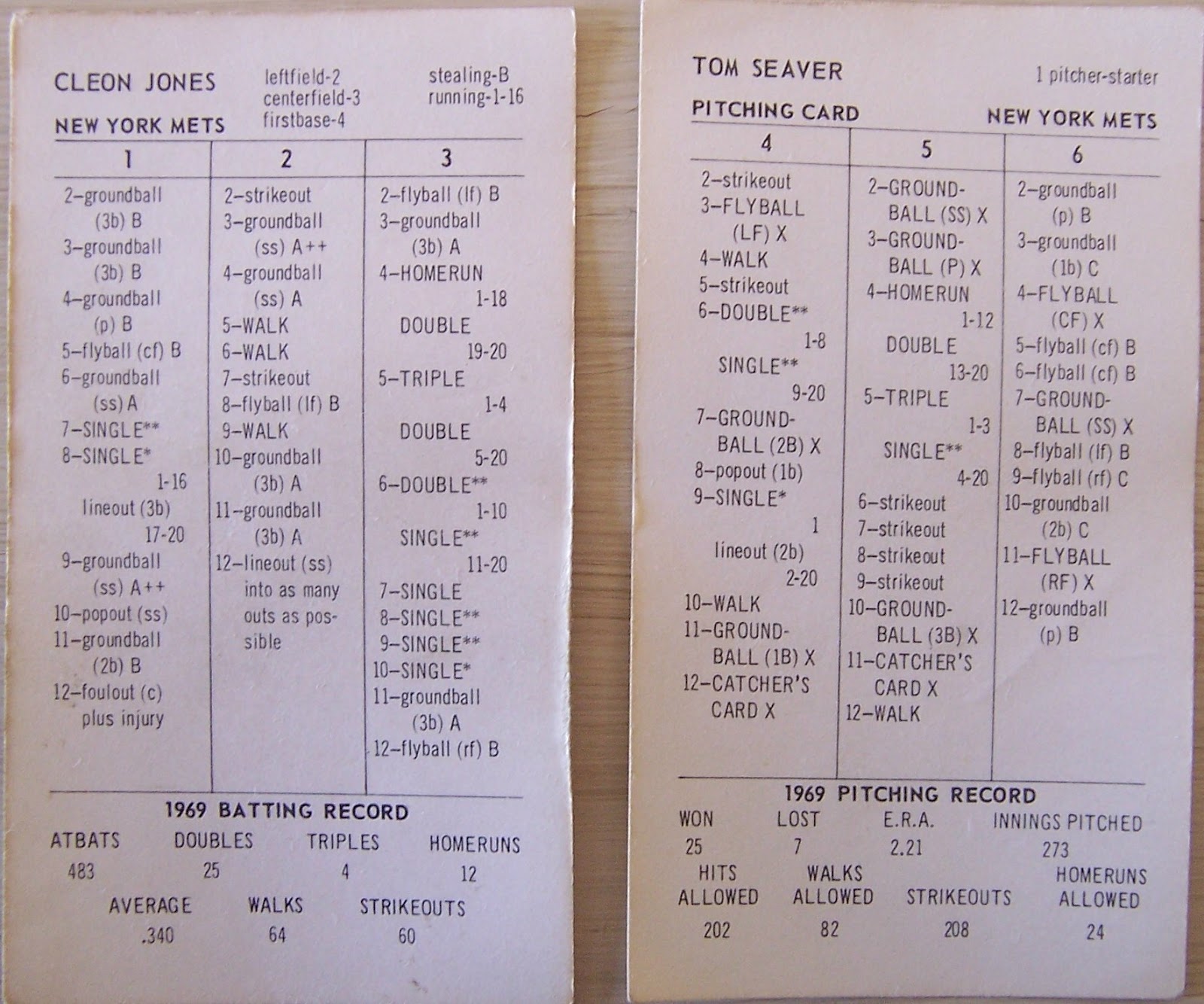
Before I get ahead of myself, however, some explanation may be in order for the un-initiated. Each season, Strat-O-Matic comes out with a new edition of player cards – one for each player on all of the major league teams. Each card contains the player’s name and shows the highlights of his previous seasons statistics – batting average, runs scored, doubles, triples, home runs, walks and strikeouts for hitters; wins, losses, earned run average, innings pitched, hits allowed, walks, strikeouts, and home runs allowed for pitchers. The beauty of the game is in its simplicity and realism, as each player performs reasonably close to their previous season’s performance; though as in life, some players will exceed expectations and others will disappoint.

The game is played with three dice – one red and two white die – which when rolled together determine the outcome of each at-bat. The red die determines whether to look on the batter’s card or the pitcher’s card, as columns 1, 2, and 3 refer to the hitter’s card, columns 4, 5, and 6 to the pitcher’s card. The total of the two white die determine where (from 2-12) to look within the column (nowadays there is a far more advanced computer version which essentially does the dice roll for you). So, if you roll a 1-7 (red die one, white die seven), you look to the hitter’s card in column 1, number 7 for the outcome of the at bat. If you roll a 4-6 (red die four, white die six), you refer to the pitcher’s card at column four, number six. The game plays quickly and easily, with a nine-inning game played in about 20-25 minutes. Each card contains its own personality, as a singles hitter like Matty Alou or Pete Rose might have a row of singles mixed in with a few walks scattered in other columns, while a power hitter like Willie Stargell, may have HOME RUN at 1-4, 1-5, and 1-6, followed by doubles and singles in the 1 column and a series of walks in the 3 column. A good pitcher’s card, however, like Tom Seaver’s 1969 card, could shut down a good offense with rows of outs in the 4, 5, and 6 columns.

The simplicity and personality of the player cards captured my imagination, but the ability to manage the team, choose the lineups for each game, decide who would leadoff and hit cleanup and which pitcher would start that day’s game, is what hooked me. I decided when to platoon a position player; when to steal, hit-and-run, bunt, and play the infield in; when to pinch hit for the pitcher, make a late inning defensive replacement, and intentionally walk an opposing batter.

Each player is rated individually for such things as base stealing ability, base running (i.e., the ability to go from first to third or second to home on a single, or first to home on a double), fielding, and bunting ability. Within a few years of my first edition, the game developed a more advanced version with lefty-righty breakdowns, outfielder’s and catcher’s throwing arms, pitcher’s endurance, and several other highly-refined statistical differentiations, including each fielder’s range and error rates (accounting for the fact that some players cover a lot of ground while also making a lot of errors, while other players may have less range but cleanly field everything they can reach), and hit-and-run ability.

All through middle school and high school, I painstakingly kept the box scores and accumulated the season’s statistics for each 162-game season of the Cardinals. I played the same schedule the real-life Cards played, though when I checked the box scores each morning in the local paper to see how the real Cardinals did the night before, I did so in part to anticipate how “my players” would do in next year’s Strat-O-Matic season.

I still have all of my hand-kept statistics of my Strat-O-Matic seasons in the 1970’s. In looking them over recently, I was reminded that, in my first season, the Cardinals went 104-58, led by the spectacular pitching of Bob Gibson (25-5, 2.05) and Steve Carlton (21-10, 2.12) and the hitting of Joe Torre (22 HR, 102 RBI, .302), Lou Brock (.291, 107 R, 69 SB) and Curt Flood (.311, 40 doubles, 25 SB). Despite this quite impressive performance, we lost the first round of the playoffs in five games to the Cincinnati Reds, losing the fifth and final game in 16 innings by a score of 7-6, when Johnny Bench knocked in Lee May for the winning run. In looking over the box score from that game, I am forced to re-live the agonizingly painful frustration I felt as we lost in the bottom of the 16th, despite having taken a 6-5 lead in the top of that inning. Though my recollection fails me, I would not be surprised if some dice were thrown and profanities uttered, a not uncommon occurrence in Strat-O-Matic households.

It is probably fair to say that I was obsessed with Strat-O-Matic and with baseball during that time in my life, an obsession I would occasionally revisit in later years, when Strat-O-Matic developed a computerized version of the game, maintaining all of its traditional charm while keeping any statistic imaginable at your beck and call. I remember countless days sitting in class or study hall writing out my next game’s lineup, analyzing my season’s statistics, examining the upcoming schedule in anticipation of the opposing pitchers and the availability of my bullpen. I assiduously calculated the player’s stats, usually updating my stat sheet every three games or so, pencil and eraser in hand, without the aid of a calculator. To this day, I am convinced that Strat-O-Matic is why I am good with numbers. I can still calculate batting averages (hits divided by at-bats) and earned run averages (earned runs multiplied by nine, divided by innings pitched) in my head. I am not sure of what use it is to anyone, but it is a point of pride nonetheless.

Playing Strat-O-Matic baseball also made me a smarter, more informed fan. For several years straight, I knew each team’s best starting pitchers, their power hitters and base stealers, their exceptional fielders, good bunters, and which catchers were tough to steal against. And long before Billy Beane and Moneyball, I learned the value of the walk; as the “manager” of a speedy, base stealing, non-home run hitting team like the Cardinals of the 1970’s, I particularly valued a hitter’s card with a lot of walks mixed in with hits, which leads to a high on-base percentage and opens up additional run opportunities. Indeed, Billy Beane himself, and several other big league general managers, honed their analytical skills playing Strat-O-Matic.

In subtle ways, Strat-O-Matic was a teacher of life lessons; some teams were better than others, some players more valuable than others. Injuries occurred and you might have to make due for 15 games without your .363 hitter, as happened to me in 1972 when Joe Torre rolled a 1-12 (lineout (ss) – injured) and I pulled a 20 out of the split-deck pile, which was a 15-game injury. It was a bad day, but I had to deal with it. In some ways it made me more connected to the real-life team, because they were always dealing with injuries and other setbacks. I thought, If they can handle it, then so can I. In Strat-O-Matic, as in baseball, one must make the most of the talents and limitations of the players you are provided and hope that a little luck will come your way – not much different than the 1973 Mets or the 2011 Cardinals.

Strat-O-Matic required me to manage a full season with players who were as good or bad as the players in real life. And the results were stunningly accurate. In my first season, Julian Javier, the Cardinals’ second baseman, who hit .282 with 28 doubles, 2 triples, and 10 home runs in the 1969 season, hit .282 with 28 doubles, 1 triple, and 11 home runs in my Strat-O-Matic season. Lou Brock’s Strat-O-Matic batting average of .291 in over 600 at bats was only seven points lower than his real life average of .298.

And yet, as statistically-accurate as the game is, it also allows for the possibility that, in any given season, a player will over-perform or under-perform. In 1971, for example, in my second Strat-O-Matic season (playing with the 1970-based player cards), I placed a little known spot starter named Chuck Taylor in my starting rotation. Taylor had started only seven games in the regular season, finishing 6-7 with a 3.12 ERA. Under my guidance and wise counsel, however, Taylor would be a 20-game winner, finishing the season with 261 innings pitched and a record of 20-7 with a 2.00 ERA, greatly outperforming his real-life stats. Naturally, I interpreted this to mean that I was a particularly good judge of talent, as I could tell from Taylor’s player card that he was a highly underrated pitcher. Despite a team ERA of 3.11 (Gibson had another great year at 22-8, 2.06), we finished 89-73 that year, failing to make the playoffs, in part due to an inability to score runs. Joe Torre led the entire team in home runs with 14. Lou Brock once again proved the realism of Strat-O-Matic, batting .305 with 32 doubles, 5 triples, and 12 home runs in 630 at bats, compared to his actual numbers of .304 with 29 doubles, 5 triples, and 13 home runs in 664 at bats. Don’t you just love this stuff!

Over the years I have found that Strat-O-Matic has a way of connecting people. Even today, when I get together with my best friends from high school, or my brother, another long-time Strat-O-Matic player, the conversation will at some point revert to recollections of our Strat-O-Matic days. Whenever I meet another present or past Strat player, an instant bond occurs. Several attorney friends of mine have confessed to playing Strat-O-Matic as a kid (the United States Attorney for the Eastern District of Pennsylvania happens to be a former Strat player), and many famous people in the world of baseball are self-confessed Strat-O-Matic fanatics. Jon Miller and Bob Costas, two of the best baseball broadcasters of my generation, were avid Strat-O-Matic players growing up in the 1960’s and 1970’s. “From my first roll of the dice [in 1963],” Miller told Glenn Guzzo in Strat-O-Matic Fanatics: The Unlikely Success Story of a Game that Became an American Passion (Acta Sports, 2005), “I was hooked on Strat-O-Matic. I was crazed.” As a kid, Miller did the play-by-play of all of his games, mimicking Vin Scully, Russ Hodges, and Jack Thompson. “A career has to start someplace,” he noted.

Keith Hernandez, who won an MVP award as the first baseman for the St. Louis Cardinals in 1979, and who is considered among the best defensive first basemen to ever play in the National League, was religiously devoted to Strat-O-Matic as a kid. When he was invited to his first spring training in 1974, upon arrival in Florida, he discovered that his Strat-O-Matic cards and game board were missing. Upset, he called his Dad, who simply laughed and said that he had taken it out of his luggage. “Just focus on what you have to do,” he advised. Hernandez, who now broadcasts games for the New York Mets, frequently makes Strat-O-Matic references on Mets broadcasts and insists that his knowledge of the game was forever enhanced by playing Strat-O-Matic baseball.

Many other Major League players also grew up playing Strat-O-Matic, and many make it a point to check out what their player cards look like each year. Ken Singleton, who accumulated over 2,000 hits in a very distinguished career with the Baltimore Orioles, once told Newsweek, “You know you’ve really made it as a ballplayer when you see a Strat-O-Matic card of yourself.” Former Phillies center fielder Doug Glanville, a University of Pennsylvania engineering graduate who now writes a column for The New York Times, once argued with Hal Richman about his defensive rating on his Strat-O-Matic card (he was consistently rated as a “2” defensively in center field which, while good, was not the “1” rating he naturally believed he deserved).

As a teenage boy growing up in central New Jersey, Strat-O-Matic, like baseball, was in my blood. Four decades later, as I think back on my Strat-O-Matic days, I am reminded of the innocence of youth, of the need to believe in something larger than oneself. To imagine, to dream that one day there would be a Strat-O-Matic card for me; to enter an imaginary universe that simulated reality, yet was connected to the real life game; and that allowed me to enter a world that most young boys can only dream of, a big league dugout in which I called the shots, judged the talent, had input into the outcome, and accepted responsibility for the results, win or lose. This, to me, is the beauty and power of Strat-O-Matic and why it will forever find a place in my heart.

Sunday, October 30, 2011

Of Destiny and Miracles

Until now, the Cardinals had never won a World Series with a team like this. A team that was lost, left behind and stranded in the standings. A team too proud and stubborn to accept the hopelessness of the situation. A team that fought back like no other has in franchise history. – Bernie Miklasz, St. Louis Post-Dispatch
There are some things in life that defy logic and reason. This past baseball season was one of them. As a Cardinals fan, this was a season of beauty and despair, jubilation and heartache, quirky plays and momentous comebacks. When the final out of Game 7 was recorded Friday night, a fly ball lifted high in the air towards the left field warning track that was caught by Allen Craig, I celebrated, hugged Andrea and my daughter, and yelled a cheer of joy and jubilation. But mostly I exhaled a sigh of relief, my emotions having been shot these past two months in a wild season of zany comebacks, devastating losses, and up and down swings. Invested as I was in this magical, historic season, the day after was anti-climactic, sad almost, as if something special and unique had been lost, forever extinguished to the dustbin of history, lost to the invisible forces of time and memory.

I am not certain if I really believe in destiny, or in miracles, but at least in the realm of baseball, if such things do exist, I witnessed it these past two months. To explain the Cardinals comeback in Game 6 of the World Series requires more than a mere knowledge of baseball folklore and physics. Having made three embarrassing errors earlier in the game, they trailed by two runs in the bottom of the ninth inning and were down to their last strike – their last breath really – when suddenly, magically, the forces of destiny overtook the cozy confines of Busch Stadium and willed the Cardinals to victory. The Rangers had on the mound one of the most reliable closers in the major leagues, Neftali Perez, a man who throws 99-mile-per-hour fastballs mixed with devastating sliders. But in a high intensity, pressure-filled at bat, with two strikes on him, David Freese, the Cardinals’ young third baseman, a hometown kid with two injury-plagued half-seasons under his belt, drilled a two-run triple off the right field wall to tie the game. I was delirious.

A few minutes later, when Josh Hamilton of the Rangers hit a two run home run in the top of the tenth to put the Rangers back on top 9-7, it appeared as if the Cardinals had finally run out of steam. We should have known better. Since August 25th, when the Cardinals were declared dead and finished by virtually everyone in baseball before going on a five-week run that is among the most brilliant and improbable comebacks in baseball history, this team has made clear they will fight to the finish. In the bottom of the tenth, with two outs and two strikes on Lance Berkman, the Rangers again one pitch away from a championship, Berkman hit a sinking line drive into the outfield to bring in the tying run, again. So, when Freese led off the bottom of the eleventh and hit a soaring 429-foot home run into the grassy knoll beyond the center field fence to win Game 6 in dramatic, walk-off fashion, it seemed almost inevitable, the forces of destiny having officially descended upon the Cardinals faithful.

“One of the great mysteries of sports is why some teams win and others lose,” writes Tyler Kepner of The New York Times. “Is it talent? Fate? Character? Karma?” The Cardinals seemed to have all of these things this year, although it did not seem that way in Spring Training when ace pitcher Adam Wainwright was injured and lost for the season, or when 17 key players at one time or another wound up on the disabled list throughout the first four months.

This may not be the most talented Cardinals team in my lifetime, but it may be the most memorable. The Cardinals were at times exasperating this year, blowing more saves than every other team in baseball except the Washington Nationals, and setting a National League record for grounding into the most double plays in one season. And yet, there were moments in mid-September that you sensed the possibilities. The Braves were slipping, descending into mediocrity, or worse, just when the Cardinals were putting it all together. When the Cardinals took three-out-of-four from the Phillies at Citizens Bank Park in mid-September, destiny became a possibility. And then, when the Phillies swept the Braves in the final three games of the season, the Cardinals also needing to win on that final day to even have a chance at the playoffs, there was a sense that the Gods of Baseball were believers themselves.

The rest is history now. After losing the opening playoff game to Roy Halladay, and down 4-0 in Game 2 of the League Division Series against Cliff Lee, who until then had a 72-1 career record in games in which his team led by four runs or more, the Cardinals came from behind to win, and then won two of the next three to upset the powerful and highly-favored Philadelphia team, beating them on their home turf in the fifth and final game. They were not supposed to beat the Milawaukee Brewers in the League Championship Series either, and when they lost Game 1 in Milwaukee, it seemed like their magic had run out. But then they rallied to win four of the next five games against the team with the best home record in all of baseball, and another miracle was in the books.

This World Series was exceptional in part because each team was so evenly matched. Except for Game 3, when Albert Pujols hit three home runs and propelled the Cardinals to a 16-7 win, the outcome of each game seemed determined by luck and fate and plays decided by a matter of inches. If Yadier Molina’s throw to second on Ian Kinsler’s steal attempt in the ninth inning of Game 2 is a millisecond faster or four inches lower, Kinsler is out and the Rangers probably lose Game 2. If Nelson Cruz gets a better jump on David Freese’s line drive in the bottom of the ninth in Game 6, or if he stretches out just a few inches more, he probably catches the ball and the Rangers win the Series in six games. If God had been a Rangers fan, he would not have allowed a rainstorm on Wednesday night to postpone Game 6 until Thursday and make it possible for the Cardinals to start Chris Carpenter on three days’ rest in Game 7.

I cannot remember how many times this season, down the stretch in September, and throughout the postseason, that the Cardinals were deemed all but finished. But then Friday night in Game 7, when Jason Motte retired the final Rangers batter and the Cardinals jumped for joy, embracing each other like little kids who had just won a prize, the season finally came to a close with the Cardinals on top. “You gotta be a man to play baseball,” the great Roy Campanella once said, “but you gotta have a lot of little boy in you, too.” It has been tremendous fun to watch.

* * * *

As I look out my window this morning on our quiet tree-lined street in Jenkintown, Pennsylvania, the ground is covered with snow and ice, winter having come early this year. A cold, harsh chill has replaced the crisp October air and the leaves cling desperately to their branches as if caught unawares by the forces of nature. Baseball is over now and life goes on, the long season but a collage of memories as the images of this wild and magical season quickly blend into the tide of baseball history. The Cardinals will stick around for a couple of days and enjoy the moment. They will bask in the glow of victory on Sunday afternoon as they parade down the streets of St. Louis to thousands of cheering fans, forever grateful that, for one brief and glorious moment, they could forget about the struggles of everyday life and together experience a baseball miracle. The Cardinals players will then head home for the winter, to rest, reflect, and prepare for next season, when they will endeavor to repeat the illogical, beautiful, exasperating, routine zaniness that is baseball.

In a few days, as I begin my annual sabbatical from baseball, it will again be time to rake the leaves. Meanwhile, I will join the ranks of the lucky few who can sleep with the knowledge that their team has won the last game of the season. In a quiet moment, when I have time to reflect, I will replay in my mind this miraculous season to better understand just how close things really were to a completely different, less satisfying result. And I will be forever grateful to the Gods of Baseball who, this season at least, allowed an outcome that may only properly be explained by destiny and miracles.

Sunday, October 2, 2011

Still Believing in Miracles


I think it’s really good for baseball. It’s not so good for my stomach. – Terry Francona
“I hear you’re a Cardinals fan,” a co-worker said to me the other day, as I retrieved my morning coffee. A slightly disdainful glare penetrated his raised eyebrow. He looked none too pleased.

“Uh, yeah,” I replied, resisting the need to explain myself. “Yes, I am, in fact.” There, I said it, what’s it to you? “Who told you?” I asked. If you’re surrounded by assassins, the first thing you need to know is where the sharpshooters are positioned.

It is a part of life to which I have become accustomed, rooting for a team that plays 1,500 miles away in a city to which I have no physical or familial connection. I journey through life in a baseball diaspora, wandering through the streets of Philadelphia in a permanent state of isolation, an outsider, a fan in perpetual exile. It can be a lonely journey indeed.

The hometown faithful in Philadelphia have had much to cheer about these past five years, their baseball team the dominant force, along with the Bronx Bombers, in Major League Baseball. It is not something Phillies’ fans have experienced much in the past half century. Nevertheless, here we are. For the first time in 80 years, Philadelphia and St. Louis are meeting in the postseason (in 1931, the Cardinals defeated the Philadelphia Athletics in a best-of-seven World Series matchup), and the Phillies are the prohibitive favorites. They have one of the best starting rotations in recent baseball history, with Roy Halladay, Cliff Lee, Cole Hamels, and Roy Oswalt providing an excess of pitching talent that is the envy of every other team in the league. The Cardinals, by contrast, are lucky to be here, having overcome a 10 ½ game deficit in the Wild Card standings as of August 25th, surpassing the Atlanta Braves with a wild and wonderful September run and sneaking into the postseason with the help of a Braves late-season slide. It was a comeback of historic proportions in a season filled with monumental collapses and miraculous come-from-behind victories.

Four weeks ago, it appeared as if September would be uninspiring, merely a place setter until October baseball arrived, when the dominant teams could finally go head-to-head. But in baseball, as in life, expectations can easily be destroyed. Disappointment and despair once again hovered over the banks of the Charles River as the Red Sox faithful watched helplessly as their team lost 20 of its final 27 games, its lead steadily eroded by the advancing Tampa Bay Rays during the worst September downfall in baseball history. Boston’s playoff hopes still alive on the last game of the season, Red Sox closer Jonathan Papelbon was just one strike away from securing a 3-2 win over the Orioles. Then, in a flash, the Orioles ripped three consecutive hits, scoring two runs and beating the Sox 4-3. Three minutes later, Evan Longoria put the finishing touches on a 8-7 Rays victory with a walk-off home run in the bottom of the tenth against the Yankees, who just thirty minutes earlier had led 7-0 in the bottom of the eighth. It seems the Curse of the Bambino has not entirely vacated the spiritual descendants of Fenway Park.

Meanwhile, Cardinal Nation erupted in cheers as the Cardinals put the finishing touches on an 8-0 win in Houston, while the Braves, who had led the Cards by 8 ½ games on September 1st, were swept by the Phillies during the final three games, the last an extra-inning nail biter won by the Phillies in the 13th inning. The Braves had simply run out of gas.

In the movie Moneyball, Billy Beane, the Oakland A’s general manager played by Brad Pitt, downplays the importance of a winning record, because history “only remembers the guy who wins the last game of the season.” Winning a lot of games in the regular season is fine, but only one team is left standing at the end. Thus, my exuberance and delight on Wednesday night quickly turned to nervous anxiety on Thursday, as I began listening to Philadelphia sports commentators discuss how the Phillies would manhandle the Redbirds, and as co-workers and “friends” started saying things like, “Your boys are going down!” and less publishable dispensations.

I am a modest, quiet fan (this is a general observation that, unfortunately for those around me, does not apply at game time). I believe that if I brag or boast or predict certain victory, the Baseball Gods will punish me with vengeful retribution. So, I take the potshots and ribbing offered by Phillies fans in stride, waving them off with a gentle laugh and an indecipherable, “Well, yeah, we’ll see.” After all, isn’t it always better to come into a series as The Underdog, the team expected to lose? It relieves the pressure; no one expects you to win anyway.

The Cardinals were not even expected to be in the playoffs this year. They did it with a final month of inspired play and come-from-behind victories, clutch hitting and good pitching that defied what I had witnessed during the dog days of summer, when their play was, at times, abysmal, full of blown saves, running mistakes, and fielding errors at the most inopportune times. Somehow this bandaged group of over-the-hill has beens and unproven youngsters put it all together in September, just when the Braves fell apart. So, here we are. It is why I love baseball so much. David beats Goliath more than is statistically likely, and the slow, steady rhythm of three-hour games, filled with balls and strikes and foul tips, suddenly transforms into bottom of the ninth walk-off wins and come-from-behind miracles.

The Cardinals somehow succeeded this year, despite a slew of injuries to key players, including the loss of Adam Wainwright, their best pitcher and a 20-game winner in 2010, before Spring Training even started. They will have to compete now with a hobbling Rafael Furcal and an ailing Matt Holliday. The Phillies, naturally, are speaking confidently, noting how healthy they are as a team, with no injuries presently ailing their key players. Such is my luck, of course. But I am used to it. A life selflessly devoted to one baseball team is a life filled with failed expectations and disappointing finishes, the occasional moments of sheer exuberance making it all worthwhile.

But it is October now, and the team that plays the best baseball over the next three weeks will become the World Champions. As the Cardinals discovered in 2006, when they limped into the postseason with a mere 83 wins, once you get to this part of the season, miracles really can happen.

Last night, for a wonderful sixty minutes or so, it looked like 2006 could be happening all over again. Lance Berkman crushed a three-run homer off of Roy Halladay in the top of the first and Kyle Lohse set down the first eleven Phillies batters he faced. The Cards held a 3-1 lead into the sixth. But then it all fell apart, as the Phillies erupted for ten runs over three innings. Despite a late gasp from the Cards’ bats in the ninth, game one ended with an 11-6 drubbing by the Phils, my dream of a miracle deferred for another night.

Regardless of what happens from here, however, I will savor every moment of this desperate season and dream of a miracle. I will watch every pitch and second guess Tony La Russa’s managerial calls, get my hopes up when the Cardinals do well and wither in anger and disappointment when they fail. But mostly I will be doing what I have been doing for the past five decades, anticipating an extraordinary finish, trying to will a Cardinals victory against all odds, hoping that this is all part of a real-life fantasy, when the expectant dreams of youth overcome the rational anxieties of age. Until the Cardinals are forced to pack their bags and descend into the night, when my dreams of winning the last game of the season confronts the cold, dark winter, I will continue to believe in miracles.

Sunday, August 14, 2011

The Forgotten Man: Remembering Curt Flood

I’m a child of the sixties, I’m a man of the sixties. During that period of time this country was coming apart at the seams. We were in Southeast Asia. . . Good men were dying for America and for the Constitution. In the southern part of the United States we were marching for civil rights and Dr. King had been assassinated, and we lost the Kennedys. And to think that merely because I was a professional baseball player, I could ignore what was going on outside the walls of Busch Stadium. . . All of those rights that these great Americans were dying for, I didn’t have in my own profession. – Curt Flood
In the summer of 1967, when I was eight years old, baseball grabbed my soul and the St. Louis Cardinals captured my loyalty. Like any young boy with a love of the national pastime, I had my favorite players, Lou Brock, Bob Gibson, Curt Flood and Orlando Cepeda. These were the players I imitated in my backyard and whose box scores I checked each morning. The Cardinals were a colorful, exciting team in the late sixties, a racially mixed band of brothers who played together in America’s Heartland. Today, when people ask me how a kid from New Jersey who never lived within 1,500 miles of St. Louis became a lifelong Cardinals fan, I invariably explain that, long before anyone informed me that one was supposed to root for the home team, I fell in love with the birds on the bat, the bright red and white classic uniforms, which looked especially good on the speedy Brock, the agile Flood, the athletic Gibson, and the powerful Cepeda.

In the first week of October, at the start of the third grade, I rushed home from school each afternoon to watch the Cardinals play the Red Sox in the 1967 World Series. When Gibson recorded the final out in Game Seven and his teammates mobbed him on the field in celebration of a World Championship, I was forever hooked, permanently embedded in the soul of Cardinal Nation.

The next year, the Cardinals again dominated play in the National League and made it to the World Series for a second consecutive season. My passion for the game and my favorite team became more deeply entrenched. It was then that I took notice of Curt Flood. Although I did not yet realize it, history would mark Flood as the most interesting and complex of the men included among my favorite players.

A quiet, lesser known star, small in stature, only 5’7” and skinny, a fun player to watch, Flood combined speed and agility, a masterful glove, and a quick bat. Hitting behind Brock in the Cardinals lineup to form a speedy one-two leadoff punch that wreaked havoc on opposing teams, Flood batted .301 in 1968, the Year of the Pitcher, when the league average was a mere .236. But it was Flood’s defense that set him apart. He climbed outfield walls and robbed opposing players of home runs and extra base hits. He closed outfield gaps and chased down floating bloopers that fell for singles against less skillful center fielders. His outfield play resulted in seven consecutive Gold Glove awards and, before season’s end, Sports Illustrated deemed Flood “baseball’s best centerfielder.” Flood’s stellar performance that year helped lead the Cardinals to a second consecutive National League Championship. Ironically, it was Flood’s misplay of a fly ball in Game Seven of the 1968 World Series against the Detroit Tigers that led to the Cards’ defeat.

I remember coming home from school, anxiously anticipating the game and hopeful that the Cardinals would repeat as World Champions. Gibson was on the mound, pitching another of his post-season masterpieces, having retired 20 of the first 21 batters he faced. In the bottom of the seventh inning, with two outs and two on, the score tied 0-0, Gibson fired a strike to Jim Northrup, who smacked a line drive into center field, seemingly in Flood’s direction and a ball he normally tracks down easily. But on this October afternoon, the sure footed Flood misjudged the ball, moving a few steps in before realizing the ball was sailing over his head. He quickly changed direction, then lost his footing on the slippery turf (it had rained the night before), as the ball sailed past his outstretched arms and onto the warning track. Two runs scored as Northrup hustled into third base with a triple. Bill Freehan followed with a double and, just like that, the Cards trailed 3-0. Gibson allowed another run in the eighth and, despite a Mike Shannon home run in the bottom of the ninth, the Tigers went on to win the game 4-1 to become the new World Champions. I was devastated.

Afterwards, some Cardinals’ fans and members of the press blamed Flood for the loss. If only Flood had caught Northrup’s fly ball, they said, the game’s outcome would have been different. Asked after the game if he blamed Flood for the loss, Gibson said, “If Curt Flood can’t catch that ball, nobody can. I’m certainly not going to stand here and blame the best centerfielder in the business.” But baseball, like life, can be cruel to those who fail. Flood would later admit that he never really got over his misplay.

Socially and politically, 1968 was a pivotal year in American history, and it marked the start of my political consciousness. I became increasingly aware of the world around me – the raging war in Vietnam, images of American soldiers coming home in body bags, civil unrest on America’s campuses, the assassinations of King and Kennedy, riots in American cities, growing racial hostility, and a nation bitterly divided. America grew up in 1968 and would never again be the same.

As a young boy, baseball was a reprieve from the messy reality of everyday life, the pressures of school, of trying to fit in, of the anxieties of adolescence. The majestic cathedrals of diamond-shaped fields, of grass and dirt and symmetry, of hot dogs and Cracker Jack and men playing a boys game, provided an innocent escape and an oasis of solace in a fast-paced, ever changing world. Even today, a baseball game in the background or a night at the ballpark presents a reminder that not all of life’s challenges need be resolved immediately.

So, when at the end of the 1969 season, the Cardinals announced they had traded Curt Flood to the Philadelphia Phillies and he refused to go, a breach encumbered that invisible line of innocence dividing baseball and politics. My first reaction was disappointment, not that Flood refused the trade, but that the Cardinals would trade the league’s best centerfielder and one of my favorite players. I really did not understand Flood’s stand; I knew nothing of the reserve clause or the concept of free agency. All I knew was that one of my favorite players would no longer be on the Cardinals and might not even remain in baseball. It was all too much for me to absorb.

In fact, Flood rejected the trade and threatened to leave baseball for good rather than be forced against his will to play for a team that he did not want to join (at that time, Philadelphia had a reputation as a difficult city for a black player). He believed fundamentally that the inequities to the players in baseball’s reserve system, which essentially tied each player to one team for life to be released or traded at the owner’s discretion, were too great. As Flood wrote to Commissioner Bowie Kuhn when he refused to report to the Phillies, “After 12 years in the major leagues, I do not feel that I am a piece of property to be bought and sold irrespective of my wishes. . . . Any system that produces that result violates my basic rights as a citizen and is inconsistent with the laws of the United States.”

Flood sued Major League Baseball and challenged the reserve clause, contending it was illegal and made possible only by baseball’s exemption from the antitrust laws. This exemption applied to no other business or sport and was a relic of a Supreme Court decision authored by Oliver Wendell Holmes in 1922, which most legal experts believed was fundamentally illogical and flawed. But overturning a Supreme Court precedent is extremely difficult, and Flood was warned by his attorneys and by Marvin Miller, the head of the Major League Players’ Association, that he would likely lose his legal challenge and jeopardize his baseball career. As a 32 year-old ballplayer, among the best in the game and paid handsomely (he made $90,000 in 1969, well above the league average in those days and many times more than what the average American worker made), he had a lot to lose. But he felt that, even if unsuccessful, he could at least expose a system he believed morally corrupt.

Flood later acknowledged that the color of his skin made him especially sensitive to the inequalities of the reserve system, to which he had become increasingly aware during the second half of the 1960’s as rising black consciousness began to influence African Americans, including himself, across the country. But he insisted that his legal action was not motivated by race and that he was prepared to risk his career as a ballplayer on behalf of other players. “What I really want . . . is to give every ballplayer the chance to be a human being,” he told one reporter, “and to take advantage of the fact that we live in a free and democratic society.”

Flood publicly equated the reserve system to a form of slavery. “A well-paid slave is nonetheless a slave,” he said. For black ballplayers, the reserve system was a subtle reminder of what had been done to their grandparents and great grandparents. But it was difficult for most fans to feel great sympathy for Flood. He was ridiculed as a $90,000 a year slave. He quickly found himself alone, without a job and no longer playing the game he loved. Worse, he was a black man challenging America’s national pastime. He received hate mail spewed with racial epithets. But most disappointing to Flood was the fact that he received virtually no support from active players. Even Bob Gibson, Flood’s best friend and former roommate, remained publicly silent about Flood’s efforts. As Gibson acknowledged years later, “I had a career to protect and a family to support, and I wasn’t willing to risk all that.”

The personal toll on Flood was substantial. He ran out of money and lost his businesses. Embroiled in financial and legal troubles at home, he fled to Denmark. There, Flood found temporary solace and resumed painting (Flood was a talented artist), but for the first time in his life, he was a man without a country. He drank heavily and suffered from bouts of depression. He lost contact with his five children, and though he would try to re-connect with them later in life, the damage was done.

Back in the states, a federal judge rejected Flood’s legal challenge to baseball’s reserve clause and, while the case was pending appeal, Flood found himself in more legal trouble, as several lawsuits were filed against his failing businesses. The financial pressures proved too much. The next year, Flood relented and signed a contract with the Washington Senators. But the time away from baseball – he missed the entire 1970 season – and drinking, smoking, and womanizing had taken their toll. His skills had diminished substantially, and the damage was palpable. On April 27, 1971, just three weeks into the regular season, Flood retired from baseball for good. He wrote a note of apology to his teammates and, without any notice, boarded a plane for Spain.

Although the United States Supreme Court agreed to hear Flood’s case, on June 19, 1972, the Court ruled in baseball’s favor, refusing to overturn Justice Holmes decision of 50 years earlier. Flood had lost his fight with baseball.

Flood was a virtually forgotten man, living anonymously in Spain. He ran a pub called The Rustic Inn. Behind the bar were displayed one of his old bats and his baseball glove. In Spain, people did not know much about him and no one asked any questions. But he continued to drink and eventually ran into trouble with the Spanish authorities, abandoned his bar and moved to Andorra, where he worked as a carpet layer. He later moved to Puerto Rico and the Dominican Republic before returning home to Oakland in 1976.

When Flood returned home, he found that baseball had changed dramatically. Through the efforts of Marvin Miller and the players’ union, the owners agreed to allow free agency for players with six or more years of playing time. By the time Flood returned to the United States, some players had been awarded million dollar contracts with multi-year deals and no-trade clauses. For the next two decades of Flood’s life, he observed other players benefit from the fruits of his sacrifice. The only person who had lost, it seemed, was Flood himself.

As a ten year-old boy, I did not fully appreciate or understand the significance or even the motivations of Flood’s refusal to be traded to the Phillies. I recall hearing talk that players should not be “owned” and forced to play for a team that they did not wish to play for, but I failed to understand that Flood’s stand was one of principle, influenced in part by the increased black consciousness of the Sixties and the civil rights era, the Black Power movement, and the principles of American democracy. A soulful, sensitive and intelligent man, he got along easily with most everyone and, like Martin Luther King Jr., whom Flood idolized, he judged every man and woman by the content of their character. But like most of the black players that made their way up the ranks of major league baseball in his era, Flood had experienced severe racism, especially in the mid-1950’s when he played for minor league teams throughout the south, where the black players were not allowed to stay in the same hotels, or eat at the same restaurants, as the white players. It was an unending list of humiliations and degradations that only a black man living in America under those circumstances could fully appreciate.

Had I been in Flood’s shoes in 1969, I would have taken the easy, non-confrontational route, like every other major league player. As a fan, I wish I could have seen Flood play baseball for a few more years in his early thirties. But I finally understand better why he felt it necessary to take this unpopular stand. As Marvin Miller told author Alex Belth in Stepping Up: The Story of Curt Flood and his fight for Baseball Player’s Rights (Persea Books, 2006), Flood was not only a superb ballplayer and great teammate, he was “someone who thought about social problems and about injustice and who was willing to sacrifice a great deal to try and change things.” He was “a genuine role model” and a man of “integrity.”

Like most men and women of history, Flood was personally flawed. He was a neglectful father, a poor husband, a failed businessman; he drank too much and found it easier to run to Europe to paint portraits at sidewalk cafes than face his problems at home. I can no longer view Curt Flood through the eyes of a ten year old boy, who thrilled at seeing Flood climb the outfield wall and rob an opposing player of a home run. With the benefit of history and five decades of life, I can now remember Flood as a great player who sacrificed some of his best years to correct a perceived injustice and as a man willing to give up everything, rightly or wrongly, to accomplish what he thought was fair and proper. In this respect, he was a rare man indeed.

Sunday, February 20, 2011

The End of Winter

Don't tell me about the world. Not today. It's springtime and they're knocking baseballs around fields where the grass is damp and green in the morning and the kids are trying to hit the curve ball. ~Pete Hamill
Pitchers and catchers reported a week ago. The “regulars” rolled in just the other day. In Arizona and Florida, at least, spring has officially started. For those of us restricted to northern terrains, a sunny day and a picture of young men tossing long-ball will suffice. Baseball is as much about imagination as reality, allowing grown men to overcome abandoned dreams and to be transported in time to the simpler days of youth. For baseball fans, spring is when the cool winds of March and the smell of a leather glove awaken in the senses the hope of new beginnings, when every team is a contender. This year is no exception.

Winter in Philadelphia lingers as the last remnants of snow refuse completely to disappear, the sun’s rays meekly penetrating the cold air. Although nature bequeathed us a day or two of softness, a February flirtation with the gentle touches of spring, the winds quickly strengthened in intensity and the temperatures dropped once again, permitting us to escape the harsh chill of winter only in the daily reports of the Grapefruit and Cactus Leagues.

My normal excitement level for the start of spring training and anticipation of a new season has been tempered this year by a reminder of the darker, business side of baseball, talk of money and contracts, revenue and payrolls. I speak particularly of the Albert Pujols contract negotiations, which for Cardinals fans is the source of sleepless nights and intestinal distress. For those of you living on the planet Zortec, let me explain. Pujols is in the last year of an eight-year, $111 million contract. If the Cardinals cannot find a way to sign him to a new deal by the end of this season, he becomes a free agent and the Cardinals, a team of moderate wealth and a payroll that befits its Midwestern television market, will have to compete potentially with every team in the Major Leagues to bid on his services. That means that the Yankees, the Red Sox and, God forbid, even the Cubs, will legitimately be allowed to offer Pujols any amount of money they are willing to dish out to lure him to their team. Some might call that free enterprise. I call it Armageddon.

Being a fan requires certain fortitude and a willingness to endure pain and heartbreak. Only true fans can really understand this. When everyone else says, “Grow up” or “Get a life”, we just shake our heads with the knowledge that the non-fan lacks discernment. A true fan connects to a team the way one connects to immediate family; we are wrapped up in our team’s identity, its players form part of our secret inner circle. I can criticize a player on my team, but if a Phillies fan knocks my second baseman, they just may find extra spices in their cheese steak, if you catch my drift. The star players, of course, are extra special, for they disappoint us less and provide us with the hope of a winning season and the dream of a championship. The longer a star player remains with us, the more we identify with him.

I became a Cardinals fan in the spring of 1967, when I was eight years old. Yes, I know, I am from New Jersey. It is simple really. My second grade class was studying the many different species of birds. Always one to choose favorites, I took an immediate liking to the cardinal, lured by its magnificent, bright red coat and distinctive black trim. There was simply no other bird like it. As it happens, my ornothological studies coincided precisely with when I fell in love with baseball. I had started to play the game with my older brother and his friends and learned that baseball and me were a natural fit. I quickly became consumed by it. When that summer I discovered the St. Louis Cardinals and the “birds on the bat” that adorned their uniforms, I was an immediate fan. Soon I was following my favorite team and my favorite players – Orlando Cepeda, Lou Brock, Bob Gibson, Curt Flood, Mike Shannon, and Tim McCarver – colorful players who lit up a ballpark with their grace and athleticism. The bond permanently cemented in the fall of 1967 when the Cardinals won the World Series; I was forever hooked. (Only years later did I discover that it was somewhat frowned upon to root for anyone other than the home team. I have finally stopped looking surprised when someone asks me, “Are you from St. Louis?” after confiding my team loyalties.)

To this day, I identify the Cardinals of my youth with Lou Brock and Bob Gibson. Although the surrounding cast occasionally changed, especially since the advent of free agency, Gibson, like Stan Musial before him, was a Cardinal for life. So was Mike Shannon, who still does the play-by-play more than 40 years later on the Cardinals’ radio network. Brock, who the Cardinals acquired from the Cubs in 1964, remained a Cardinal until he retired in 1979. I can still recite the daily lineup card for the Cardinals teams of the late 1960’s and early 1970’s. At the age of eleven, I started playing Strat-O-Matic baseball, an extremely realistic, statistic-based board game, played with dice and individual player cards formulated from the previous season’s statistics. I “managed” eight straight 162-game seasons of Cardinals games, keeping box scores and calculating the season’s at bats and innings pitched, hits, runs, RBIs, walks and strikeouts, batting averages and earned run averages. To this day, I can compute batting averages in my head. I spent more time in study hall writing out that day’s lineup card and studying my team’s statistics than I did doing homework. Hmmm. Perhaps this is why I did not attend an Ivy League college, or why I wince when asked about the works of William Shakespeare. I mean, what was his batting average?

More than four decades hence, you must forgive my indulgence, then, of Albert Pujols. When a player is as uniquely talented and identified with one team as Pujols, it takes a bigger man than me to resist the need for common sense and patience in something as mundane and legalistic as a long-term contract. There is something a little disconcerting about the business of baseball. I am a fan because, for 2 ½ hours each night, baseball reminds me of what life was like when I was twelve, when the most important event was how the Cardinals did against the Mets. I did not know or care about the players’ salaries, or how much money the team made in a given season. I knew nothing of television royalties, ticket sales and merchandise revenues. I paid little attention to union disputes and work stoppages. It was the game and what it represented, devotion to a team and identification with its players, which captured my imagination.

I understand that the Cardinals must protect the future of the franchise. Pujols is 31 years old. He will turn 32 before season’s end, when his present contract expires. According to unsubstantiated reports, Pujols and his agent have asked for a contract in the range of 10 years, $300 million. The Cardinals reportedly offered Pujols somewhere in the neighborhood of $200 million over nine years, plus an equity interest in the team for life. Cardinals’ management is naturally reluctant to commit 30% of their payroll for ten years on a player who, in six or seven years, will be in the twilight of his career. The Cardinals would likely agree to pay him $30 million a year for five or six years, but they do not want to be tied into a deal that pays even a player as great as Prince Albert upwards of $30 million a year when he is 39, 40, and 41 years old. Pujols is a great player, and there is no reason to believe he will not continue to be among the best players in baseball for the next several years. But even the great ones do not play at 39 the way they played at 29.

I cannot justify the amount of money we are talking about here. And yet, despite my past moralizing over the inequality of income between the rich and the poor in the United States, when it comes to baseball you can dismiss all talk of economic justice, morality and politics. There is really only one consideration. Do what it takes to win! Pujols is a once-in-a-lifetime player. His first ten years are matched historically only by Ted Williams and Joe DiMaggio. In ten seasons, Pujols has accumulated 1,900 hits, 408 home runs, 1,230 RBIs, 1,186 runs, 426 doubles, and 914 walks (compared to only 646 strikeouts). Divide each number by ten and you have pretty close to what he has done each season. He is that consistent. He has a career batting average of .331 and an on-base percentage of .426. He has never batted below .312, has never knocked in less than 103 runs, has never scored less than 99 runs. He has twice won the Gold Glove Award for his superb defensive play at first base. By all accounts, he is a great teammate and clubhouse leader.

The famous actress, Tallulah Bankhead, once said, “There have been only two geniuses in the world. Willie Mays and Willie Shakespeare.” I don’t know about Shakespeare (see above), but Albert Pujols must be added to the list. If the Cardinals do not sign Pujols and make him a Cardinal for life, I dread the amount of therapy that will be needed to restore my sanity. All of Cardinal Nation will be on Prozac. I know that it will take a lot of money to sign El Hombre, and I hope he means it when he says he wants to remain a Cardinal for life. But if somehow it doesn’t work out, if Prince Albert someday betrays Cardinal red, it will induce panic-stricken psychosis in the annals of Cardinalville. He is the franchise. He is the St. Louis Cardinals.

Perhaps it is as simple as what one Cardinal fan recently advised Bill DeWitt, Jr., the Cardinals' owner, in an email to ESPN's Mike and Mike in the Morning, “He wants it. You have it. Give it to him.” I really do not know what to think about it all. In my moments of dispassion and sanity, I can understand the reluctance to give away the store. Then the fan in me takes over, and I don’t want to hear about contracts and money and long-term revenue projections. For the past six weeks, I have awakened each morning with the hope that the headlines would read, “Cards Sign Pujols for Life.” So I have stopped trying to think about it, and will focus on the game and prepare for another long and beautiful season, when my childlike fascination with baseball and the Cardinals will overtake all the messy details of life.

Ernie Harwell, the longtime announcer for the Detroit Tigers, once said, “Baseball is just a game as simple as a ball and bat. Yet, as complex as the American spirit it symbolizes, it is a sport, a business, and sometimes almost even a religion.” As a rational man with a sense for business and economics, I understand the arguments on both sides of the Pujols contract negotiations. But as a Cardinals fan, I simply cannot comprehend life without Pujols.

Tuesday, July 13, 2010

Random Thoughts at the All-Star Break


The extended heat wave of early July has finally subsided in eastern Pennsylvania, at least for a brief moment, so I exhale a sigh of relief, comforted by the thought that for three days the baseball season begins a short hiatus to accommodate the annual All-Star game. Although the season is already several games into the second half, the All-Star Break is baseball’s unofficial halfway point. The Cardinals enter the break in second place in the National League’s Central Division, only one game behind the surprisingly strong Cincinnati Reds. The dreams of a glorious season that enraptured Cardinal Nation on Opening Day are tempered by the long grinding struggle that is, in reality, the 162-game baseball season. Cardinals’ fans remain cautiously optimistic, hoping for a second half surge that will end in ninth-inning walk-off celebrations, home plate mob scenes and ticket-tape parades. But nagging injuries – Ludwick’s calf, Freese’s ankle, Rasmus’s hamstring, Penny’s lateral quad muscle, and Lohse’s forearm, among others – transform our imagined glory into anxiety-ridden, inning-by-inning, nail biting misery. Such is the life of a baseball fan.

It is during these brief moments of sanity, in the quiet solitude of an off day, when I understand why those closest to me may mistakenly believe that my life during baseball season falls into an abyss of warped priorities. Waking up early each day, I catch the train into town and work in the office, often not returning until 7:30 or 8:00 p.m. Arriving home at the edge of dusk, I feed my daughter’s guinea pig, make dinner, and watch that night’s Cardinals’ game, which monopolizes my time until after eleven, sometimes approaching midnight. This of course adds severely to my cumulative sleep deprivations, which are particularly magnified when the Cardinals play on the West Coast. When I explain that “my team” needs me, that I am certain Tony LaRussa and Dave Duncan rely on my telepathic instructions to Schumaker and Pujols to lay off breaking balls in the dirt; to Holliday and Rasmus to hit the cut-off man on throws from the outfield; and to Suppan and Hawksworth to keep the ball down, I am met with the cynicism of rolling eyes and shakes of the head. “Baseball is not necessarily an obsessive-compulsive disorder,” Thomas Boswell of the Washington Post has said. “You can be a truly dedicated, state-of-the-art fan or you can have a life. Take your pick.”

Adding to my “managerial” obligations are my many parental responsibilities – teaching Hannah to drive (which makes a hair curling, extra-inning drama seem like a relaxing weekend in Stone Harbor) and offering Dad-like advice to two skeptical, independent-minded teenage daughters neither of whom are much impressed with the demands of my unremunerated (and officially unacknowledged) internship with the St. Louis Cardinals Baseball Club. In my remaining spare time, when not cutting the grass or running errands, I agonize over the final touches of “Ehlers on Everything” and respond to the right-wing rants of my critic-in-chief and ideological nemesis, the infamous “Rich R.”, who tenders unsavory disputations on every word, phrase, or grammatical deviation that hints of liberalism.

So as I ruminate at the All-Star Break, confronted with three nights and no Cardinals games, I have a moment to reflect. Here, then, in no particular order, are some random musings and thoughts on the state of the world as seen through the eyes of a sleep-deprived and unpaid writer, political philosopher, amateur theologian, and baseball manager:

On Politics:

· Has America always been a house divided? As splintered and rancorous as America at times appears to be, is it really any worse than the state of affairs during the late 1960’s and early 1970’s, when as a nation we were so intensely divided over the Vietnam War and civil rights that students were gunned down by the National Guard and our nation’s cities were the scenes of repeated rioting? It was a time when entire generations spoke past each other and our youth experimented to excess with newfound sexual freedom and drug use, when an anything-goes culture clashed with the staid conformity and repressed instincts of the fifties. By comparison, today’s blue state - red state divisions do not look that bad. Yes, we have Tea Party protests and disruptive town hall meetings, but there is an element of healthy debate in some of this. Compared to the early seventies, when the Weather Underground was blowing up public buildings and a segment of our youth was turning on and dropping out, there are some aspects of today’s political culture that, however screwed up, are an improvement upon forty years ago. A little less interesting, mind you, but distinctly healthier.

· Has anyone figured out what the Russian spy scandal was actually about? From what I can tell, the closest thing to a state secret revealed was the new menu offering from Wendy’s.

· Does Nicholas Kristof have a point? The liberal New York Times columnist has been on a pro-Palestinian kick lately; a thoughtful one, offered with his typical humanitarian flair, but in this instance I worry he has lost balance and, as is often the case with perspectives on the Israeli-Palestinian dispute, a sense of recent history. I agree that the Israelis mishandled the Turkish flotilla raid that led to nine deaths, and they were right to ease the blockade of goods being imported into the Gaza strip, but the bad guys remain the leaders and members of Hamas. Until its leaders speak and act differently – acknowledge Israel’s right to exist and stop lobbing unprovoked missiles into the suburbs of Tel Aviv – I cannot generate much sympathy for them. It is unfortunate that the more reliable defender these days of the only democracy and glimmer of hope in the Middle East is not the liberal establishment but, rather, conservatives and evangelical Christians.

· Where is the outrage? Oil continues to spill into the Gulf of Mexico at alarming rates, killing fish and wildlife and upsetting ecosystems, disrupting the lives and destroying the livelihoods of tens of thousands of residents on the coasts of Louisiana, Mississippi, and Alabama. If the Deepwater Horizon disaster does not cause us to hesitate with further offshore drilling ventures, reconsider our energy policies, and recommit to green energy solutions, we are destined for a future of continued dependence on foreign oil, irreversible climate change, and economic troubles. As Gretel Ehrlich, writing for Sojourners, recently said: “We’ve forgotten that when we step down on the earth we are walking on a living membrane. Now we are wounded people recklessly pimping a wounded planet. We’ve turned away from a sacred view of the world, a deep openness in which we accept that all living things have value. We’ve drilled recklessly under the ocean floor for economic gain, and in the process exchanged a sense of well-being, beauty, hope, and wonder for the myopia of profit.”

· Is Rush Limbaugh serious, merely delusional, or a complete fraud? Limbaugh has repeatedly portrayed President Obama as an “angry black man” who is intentionally tanking the American economy in order to obtain “economic reparations” for minorities. Not only does this make no sense, it is so disingenuous that I find it impossible that the fat windbag actually believes most of the verbal trash he spews on the airwaves.

· Should we be worried? Chris Matthews warned last week that the Democrats should take Sarah Palin seriously, that she could actually make a credible run for the White House in 2012. Her unfavorable ratings still seem too high, in my opinion, for her to be a serious threat, and I do not believe she can withstand the intense media scrutiny that presidential elections impose. But Matthews knows a thing or two about American politics, so if he says she could win, it is a matter of concern for sane, rational Americans.

On Law:

· What’s in a lawsuit? The Department of Justice was correct to enjoin Arizona from enforcing its new immigration law. The doctrine of federal preemption renders the state law unconstitutional. This is a non-political, legally correct position that even the Bush administration would have had no choice but to assert as well. Federal immigration policy has national and foreign policy implications, it affects our relations with sovereign nations, international aid groups, and it requires substantial coordination of federal law enforcement resources. We cannot realistically have 50 different immigration policies scattered among the states, particularly when the federal government (Immigration and Customs Enforcement) is required to implement the deportations and detentions that would result from laws like that in Arizona. That said, it is long past time for Congress and the President to enact comprehensive immigration reform.

On Life:

· Is the United States in the midst of a tattoo epidemic? Or is it only Philadelphia? The many and varied forms of displayed body art that I observe on my walks through center city remind me of building graffiti and subway art, except that the tattoos are less aesthetically pleasing.

· Why did I join the private sector? A recent survey of the federal workforce showed that 8 in 10 federal employees like the work that they do, and more than 90% think that what they do is important. This is how I felt for the nearly 20 years I worked in government, when I possessed a heightened sense of self-worth and the feeling that what I did mattered, that I was contributing, if only in a small way, to an effective criminal justice system and a functioning Constitution. Oh, yeah, the money.

On the Cult of Celebrity:

· Why should we care about the fate of Lindsay Lohan? Don’t misunderstand, I feel sorry for her in the way I feel sorry for any anorexic, drugged out, over-partied, spoiled brat with a bad father, but do we really need to devote that much air and print time to such a trivial story? Is she not just one more of the hundreds of examples, from Judy Garland to Gary Coleman, of child stars being consumed, exploited, chopped up and discarded by a narcissistic Hollywood culture of breast implants, glorified drug use, money and superficial glitz?

· Speaking of role models, is Cleveland really such a bad place to live? I am not sure whose idea it was for LeBron James to waste sixty minutes of national television time announcing that he has chosen “South Beach” (not Miami mind you) in which to spend the next several years of his NBA career, but he could have more easily and tactfully humiliated the fans of Cleveland with a press release.

I believe there ought to be a constitutional amendment outlawing Astroturf and the designated hitter. --Crash Davis in “Bull Durham”
As with changes to baseball’s grand traditions, social and political progress often advances gradually and in small increments. Just as with the elimination of artificial surfaces in most major league ballparks, Don’t Ask, Don’t Tell will eventually be repealed and John Edwards’ ego will eventually deflate. So, as you continue on your life’s journey, remember always the immortal words of former Yankees manager Bob Lemon, “The two most important things in life are good friends and a strong bullpen.”

Thursday, January 14, 2010

Confessions of a Home Run King in an Unforgiving World

Mark McGwire tried to come clean Monday, and in his heart he believes that he did. But understand that Big Mac was never very good at these things. A private and shy man, he’s never displayed much deftness in cultivating an image. He always wanted to hit the baseball out of sight, then remain out of sight himself.
--Bernie Miklasz, St. Louis Post-Dispatch

After a self-imposed exile and refusing “to talk about the past,” Mark McGwire has finally come clean. In a series of public statements this past Monday, McGwire acknowledged that he had used steroids on and off for a decade, starting before the 1990 season. He did not attempt to minimize his use of the drugs or suggest he took them by mistake, but explained that his use became more frequent in the mid-1990’s, when he was repeatedly on the disabled list, missing 228 games over five seasons. McGwire insisted that he did it not to gain a strength advantage, but for health reasons, to keep him on the baseball diamond and out of the trainer’s room. His career had been in jeopardy due to a ribcage strain and several heel injuries from 1993 to 1995, and he was led to believe that “steroids could help me recover faster” and might “help me heal and prevent injuries.” As it happens, McGwire’s best seasons were from 1996 to 1999, when he hit 52, 58, 70, and 65 home runs, respectively. His knees started to break down – he acknowledges now that it may have been because of steroids – in the 2000 season, when he played in only 89 games, and in 2001, when he hit a mere .187 with 29 home runs in 299 at bats (he retired after that season).

“I wish I had never touched steroids. It was foolish and it was a mistake. I truly apologize.” He said that using steroids is now his biggest regret, “a stupid act” for which he tainted his career and disappointed many people, including his family and biggest supporters. On the morning of his interview with Bob Costas on the MLB Network, McGwire called and apologized to Pat Maris, the widow of Roger Maris. It was a difficult call to make, but one that he believed was important. “She was disappointed,” said McGwire, but supportive. When Costas noted that some of Maris’s children believe their father’s record has never been authentically broken, McGwire replied, “I fully understand.” He cried several times during the interview, and to me, his tears seemed real and sincere. He was a man in pain, knowing that he had let down so many people, yet he seemed relieved to be finally letting it all out. It was a compelling interview, very moving, and one that needed to happen.

Yet I was disheartened to see that, rather than praise McGwire for finally admitting his transgressions and apologizing for his wrongs, he was immediately ridiculed and ripped apart. Ken Rosenthal of FoxSports.com chastised McGwire for “still living a lie . . . [H]e did not admit – did not want to admit, or perhaps could not bring himself to admit – that steroids helped make him a better hitter.” Jay Mariotti of FanHouse said McGwire “hid it for much too long, coming clean only after he ended his personal exile” to become the hitting coach for the Cardinals. "He had no choice . . . but to confess and tell some details – though hardly the entire story – about his relationship with ‘roids’.” Many others expressed similar views. Although McGwire wants us to forgive and move on, a seemingly reasonable proposition, and while reporters and pundits have been insisting for the past five years that he needs to admit his wrongs, there are some people who will never be satisfied, who want their pound of flesh no matter what he says or does.

It should not be surprising, given how cynical and mean spirited the entire world has become in all other spheres of life. Although Rosenthal acknowledged that McGwire “seemed truly anguished, deeply troubled by what he had done,” it was simply not good enough for McGwire to admit that much of his career is tainted, or for him to confess his sins and break down in tears on national television. It makes one wonder whether the next player who wants to unburden his conscious will now have second thoughts. Why not instead take the Roger Clemens approach and essentially say, Screw you, everyone, I admit nothing.

One of the most astute observers of the whole McGwire affair is Bernie Miklasz of the St. Louis Post-Dispatch. Miklasz took to task many of the baseball pundits and other critics who have ridiculed McGwire and relentlessly dissected his admissions. “[N]o matter what McGwire said, or how he said it, the guy was going to be picked apart.” For years, sportswriters and broadcasters have been demanding that McGwire break his silence and come clean on his use of steroids. Americans are a forgiving people, so it was generally assumed that, “so long as McGwire came clean, he’d score a lot of points and earn respect.” Yet that is not what happened.
McGwire was more honest and open and candid than any of the sluggers tainted by the steroid era. In terms of his forthrightness, McGwire easily surpassed the forced confessions of Alex Rodriguez and Andy Pettite, or assorted clowns who failed steroids tests and attributed it to taking the wrong medication by mistake. I didn’t agree with some of McGwire’s answers, but he was much more of a man than any of these other guys. But in the end, it didn’t matter much. This is what we do in the media, and it’s a two-step process: (1) moralize and demand a confession; (2) moralize and condemn after the confession is offered. . . . Let’s face it: these guys can’t win. Because even when they choose to ‘fess up, we change the parameters on them after the fact.
I will be the first to admit that, when McGwire was belting 480 foot home runs for the St. Louis Cardinals in the late 1990’s, I was among his biggest fans. I personally saw McGwire hit 10 home runs over the course of four seasons, each one a monstrous blast, louder, higher, and farther than other players’ home runs. It was a thing of beauty. Whenever the Cardinals came to Philadelphia, I would get to the ballpark early so as not to miss batting practice. I must have seen McGwire hit at least 100 batting practice home runs; everyone stopped what they were doing to watch him swing the bat. Twice I saw McGwire hit three home runs in a single game at Veterans Stadium in Philadelphia, each one sailing high and deep into the upper deck of that vast, spacious ballpark, bouncing off the empty seats in no man’s land, one ricocheting off of the center-field scoreboard.

Fans and players alike were in awe of McGwire. Although I heard the whispers of suspicion, I believed it possible that he was a naturally big, strong athlete, who had simply worked hard to develop his Paul Bunyan physique. After all, no one disputed that McGwire was a gifted athlete, possessed with natural talent to hit a baseball. He hit a home run his first time up in Little League and, as he told Costas, people still talk about the home runs he hit in High School ball, in American Legion ball, and in the Minor Leagues. And McGwire hit 49 home runs as a skinny rookie in 1987, long before any steroids ever touched him. So I wanted to believe McGwire’s denials. I wanted to believe that he was a really good guy, honest and forthright, as well as a great hitter. I joined the Feel Good Party, made up of fans, sportswriters, managers, and front office personnel, all of whom turned a blind eye towards what in retrospect seemed obvious. The McGwire-Sosa home run battle of 1998 was fun and exciting and represented, so we thought, everything that was good and decent about the game, a positive diversion from the daily news cycle that talked non-stop of the Clinton-Lewinsky scandal, impeachment hearings, embassy bombings, and UN weapons inspections.

Of course, McGwire was hardly alone in his sins. It is generally assumed that a large number of players, possibly a majority, also used steroids from the late 1980’s through the 1990’s and beyond, that it was part of the game. The home run totals in the major leagues were off the charts during the Nineties, something that is difficult to attribute to better training methods and coincidence. Players are certainly better conditioned today than they used to be, more conscious of weight training, stronger and bigger (legitimately), but for certain players, like McGwire, Bonds, Sosa, and many others, the difference in body mass from their early playing days to their later playing days (when their skills should be on the decline), was too stark to ignore.

So while I am disappointed that one of my baseball heroes is less than perfect, and that his achievements and records are now to be forever questioned, I am happy that he has finally told the truth about his past, that he can get back into the game that he so loves and to which he has much to contribute. And I wish that people would be a little more forgiving, a little more compassionate. There are far worse things in life that people can do. McGwire has been punished and chastised enough. He will never be admitted into the Hall of Fame, despite his 583 career home runs. He will forever be associated with the Steroid Era. But he is a decent man who was an excellent teammate, is a generous contributor to worthy causes (he started a foundation to benefit the victims of child abuse, a subject very close to his heart), and who, by all accounts, is a good father.

I believe McGwire really does believe that steroids did not enhance his performance; it is understandable, for he was the one who actually hit the home runs. It was his hand-eye coordination, his timing, and his swing that connected with each 93 mile-an-hour fastball that sailed into the hinterlands. He cannot now take those home runs back, and in his mind, he hit them based on his skill as a baseball player, on the work he put in year-after-year in shortening his swing and studying the opposing pitchers. So, I understand his mindset, even if I think he may be wrong. For while he no doubt became a better hitter as he got older, shortening his swing and taking smarter at bats, and while he always had great bat speed and immense power (long before he ever started taking PEDs), if the steroids helped him stay healthy and helped his muscles recover more quickly when he was 35, 36, and 37 years old, then they enhanced his performance, allowing him to play at a high level when other players have to hang up their spikes.

McGwire deserves our praise for coming clean, and we should not chastise and ridicule his efforts, even if we disagree with some of his assertions and beliefs. We should understand that, as a proud and vulnerable man, McGwire gave a lot of himself to admit what he did. Does it really matter that he does not perceive all aspects of his transgressions in the same manner as Ken Rosenthal? Importantly, McGwire said that, had Major League Baseball tested for steroids in the 1990's, he would not have used them. But no one seemed to mind back then, indeed everyone embraced the home run displays of McGwire, Bonds, and Sosa. There are a lot of parties complicit in this whole sordid affair. We don't have to like that McGwire took steroids, we can keep him out of the Hall of Fame and place an asterisk by his home run records. But the Costas interview helped me, at least, better understand his motives and appreciate his humanity. It is time to accept his apology and grant him personal (if not professional) forgiveness; time to move forward and restore integrity to the game of baseball.

Most Popular Posts in the Last Year