Showing posts with label Bob Costas. Show all posts

Friday, March 9, 2012

Strat-O-Matic Memories: The Baseball Years

Statistics are the food of love. Baseball is nourished by numbers, and all of us who have followed the game with intensity have found ourselves transformed into walking memory banks, humming with games won, games lost, batting averages and earned-run averages, games started and games saved, "magic numbers," final standings, lifetime marks, Series, seasons, decades, epochs. -- Roger Angell
In March of 1970, a month shy of my eleventh birthday, a delivery from the UPS truck changed my life. It was my first edition of Strat-O-Matic baseball, a board game that forever altered the way I viewed and enjoyed baseball. Long before Moneyball, years before Fantasy Baseball and Rotisserie Leagues, Strat-O-Matic filled the time and imaginings of teenage boys throughout the United States. Founded in 1961 by Hal Richman, a middle-class kid from Long Island who parlayed a $5,000 loan from his father to create what would become, and has remained, the single greatest baseball board game ever invented, Strat-O-Matic has been played by baseball fans of all stripes for the last half century, from young boys to grown men, from major league ballplayers and sports announcers, to doctors, lawyers, and teachers.

Richman was a self-proclaimed mediocre athlete who grew up with a love of sports and a penchant for math, a combination that would serve him well in developing a flagship baseball game based on the real life performances of all of the major league players in a given season. There is no sport as statistics-driven as baseball, and no game as statistically rich, and exceedingly realistic, as Strat-O-Matic baseball. And yet, for all its realism, Strat-O-Matic possesses what Richman refers to as play value for fun, allowing its participants to enter an alternate universe, to become the manager, statistician, and play-by-play announcer all in one. With Strat-O-Matic, I managed the St. Louis Cardinals for eight seasons, temporarily forced into retirement to attend college. For 162 games a year (and more if my team made the post-season), I started each game with an imaginary playing of the National Anthem, followed by the cheers of the crowd and the roar of “Play ball!” The games were real, but not too real, as I could bench an underperforming star without risking a bruised ego or having to deal with his pesky agent.

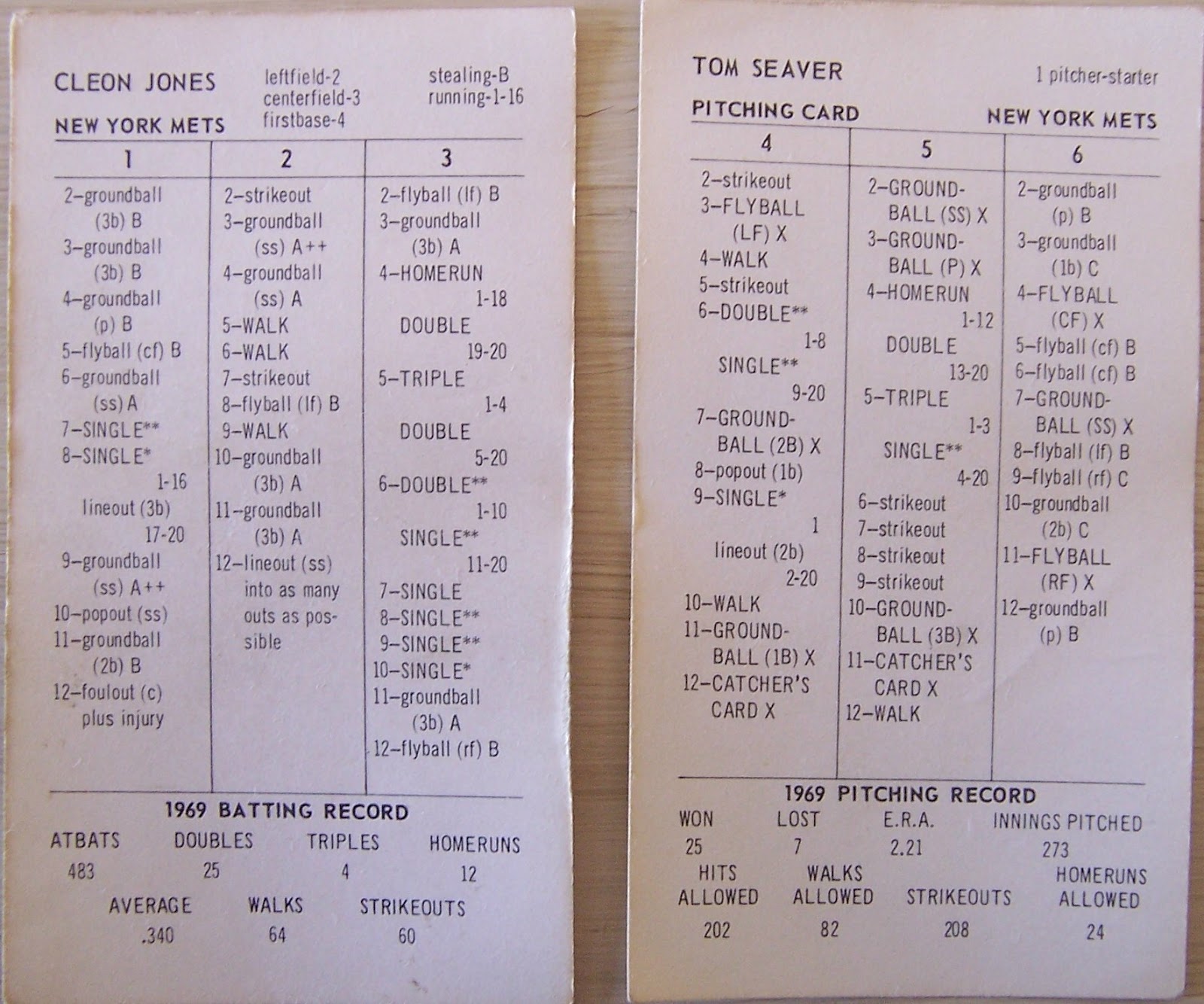
Before I get ahead of myself, however, some explanation may be in order for the un-initiated. Each season, Strat-O-Matic comes out with a new edition of player cards – one for each player on all of the major league teams. Each card contains the player’s name and shows the highlights of his previous seasons statistics – batting average, runs scored, doubles, triples, home runs, walks and strikeouts for hitters; wins, losses, earned run average, innings pitched, hits allowed, walks, strikeouts, and home runs allowed for pitchers. The beauty of the game is in its simplicity and realism, as each player performs reasonably close to their previous season’s performance; though as in life, some players will exceed expectations and others will disappoint.

The game is played with three dice – one red and two white die – which when rolled together determine the outcome of each at-bat. The red die determines whether to look on the batter’s card or the pitcher’s card, as columns 1, 2, and 3 refer to the hitter’s card, columns 4, 5, and 6 to the pitcher’s card. The total of the two white die determine where (from 2-12) to look within the column (nowadays there is a far more advanced computer version which essentially does the dice roll for you). So, if you roll a 1-7 (red die one, white die seven), you look to the hitter’s card in column 1, number 7 for the outcome of the at bat. If you roll a 4-6 (red die four, white die six), you refer to the pitcher’s card at column four, number six. The game plays quickly and easily, with a nine-inning game played in about 20-25 minutes. Each card contains its own personality, as a singles hitter like Matty Alou or Pete Rose might have a row of singles mixed in with a few walks scattered in other columns, while a power hitter like Willie Stargell, may have HOME RUN at 1-4, 1-5, and 1-6, followed by doubles and singles in the 1 column and a series of walks in the 3 column. A good pitcher’s card, however, like Tom Seaver’s 1969 card, could shut down a good offense with rows of outs in the 4, 5, and 6 columns.

The simplicity and personality of the player cards captured my imagination, but the ability to manage the team, choose the lineups for each game, decide who would leadoff and hit cleanup and which pitcher would start that day’s game, is what hooked me. I decided when to platoon a position player; when to steal, hit-and-run, bunt, and play the infield in; when to pinch hit for the pitcher, make a late inning defensive replacement, and intentionally walk an opposing batter.

Each player is rated individually for such things as base stealing ability, base running (i.e., the ability to go from first to third or second to home on a single, or first to home on a double), fielding, and bunting ability. Within a few years of my first edition, the game developed a more advanced version with lefty-righty breakdowns, outfielder’s and catcher’s throwing arms, pitcher’s endurance, and several other highly-refined statistical differentiations, including each fielder’s range and error rates (accounting for the fact that some players cover a lot of ground while also making a lot of errors, while other players may have less range but cleanly field everything they can reach), and hit-and-run ability.

All through middle school and high school, I painstakingly kept the box scores and accumulated the season’s statistics for each 162-game season of the Cardinals. I played the same schedule the real-life Cards played, though when I checked the box scores each morning in the local paper to see how the real Cardinals did the night before, I did so in part to anticipate how “my players” would do in next year’s Strat-O-Matic season.

I still have all of my hand-kept statistics of my Strat-O-Matic seasons in the 1970’s. In looking them over recently, I was reminded that, in my first season, the Cardinals went 104-58, led by the spectacular pitching of Bob Gibson (25-5, 2.05) and Steve Carlton (21-10, 2.12) and the hitting of Joe Torre (22 HR, 102 RBI, .302), Lou Brock (.291, 107 R, 69 SB) and Curt Flood (.311, 40 doubles, 25 SB). Despite this quite impressive performance, we lost the first round of the playoffs in five games to the Cincinnati Reds, losing the fifth and final game in 16 innings by a score of 7-6, when Johnny Bench knocked in Lee May for the winning run. In looking over the box score from that game, I am forced to re-live the agonizingly painful frustration I felt as we lost in the bottom of the 16th, despite having taken a 6-5 lead in the top of that inning. Though my recollection fails me, I would not be surprised if some dice were thrown and profanities uttered, a not uncommon occurrence in Strat-O-Matic households.

It is probably fair to say that I was obsessed with Strat-O-Matic and with baseball during that time in my life, an obsession I would occasionally revisit in later years, when Strat-O-Matic developed a computerized version of the game, maintaining all of its traditional charm while keeping any statistic imaginable at your beck and call. I remember countless days sitting in class or study hall writing out my next game’s lineup, analyzing my season’s statistics, examining the upcoming schedule in anticipation of the opposing pitchers and the availability of my bullpen. I assiduously calculated the player’s stats, usually updating my stat sheet every three games or so, pencil and eraser in hand, without the aid of a calculator. To this day, I am convinced that Strat-O-Matic is why I am good with numbers. I can still calculate batting averages (hits divided by at-bats) and earned run averages (earned runs multiplied by nine, divided by innings pitched) in my head. I am not sure of what use it is to anyone, but it is a point of pride nonetheless.

Playing Strat-O-Matic baseball also made me a smarter, more informed fan. For several years straight, I knew each team’s best starting pitchers, their power hitters and base stealers, their exceptional fielders, good bunters, and which catchers were tough to steal against. And long before Billy Beane and Moneyball, I learned the value of the walk; as the “manager” of a speedy, base stealing, non-home run hitting team like the Cardinals of the 1970’s, I particularly valued a hitter’s card with a lot of walks mixed in with hits, which leads to a high on-base percentage and opens up additional run opportunities. Indeed, Billy Beane himself, and several other big league general managers, honed their analytical skills playing Strat-O-Matic.

In subtle ways, Strat-O-Matic was a teacher of life lessons; some teams were better than others, some players more valuable than others. Injuries occurred and you might have to make due for 15 games without your .363 hitter, as happened to me in 1972 when Joe Torre rolled a 1-12 (lineout (ss) – injured) and I pulled a 20 out of the split-deck pile, which was a 15-game injury. It was a bad day, but I had to deal with it. In some ways it made me more connected to the real-life team, because they were always dealing with injuries and other setbacks. I thought, If they can handle it, then so can I. In Strat-O-Matic, as in baseball, one must make the most of the talents and limitations of the players you are provided and hope that a little luck will come your way – not much different than the 1973 Mets or the 2011 Cardinals.

Strat-O-Matic required me to manage a full season with players who were as good or bad as the players in real life. And the results were stunningly accurate. In my first season, Julian Javier, the Cardinals’ second baseman, who hit .282 with 28 doubles, 2 triples, and 10 home runs in the 1969 season, hit .282 with 28 doubles, 1 triple, and 11 home runs in my Strat-O-Matic season. Lou Brock’s Strat-O-Matic batting average of .291 in over 600 at bats was only seven points lower than his real life average of .298.

And yet, as statistically-accurate as the game is, it also allows for the possibility that, in any given season, a player will over-perform or under-perform. In 1971, for example, in my second Strat-O-Matic season (playing with the 1970-based player cards), I placed a little known spot starter named Chuck Taylor in my starting rotation. Taylor had started only seven games in the regular season, finishing 6-7 with a 3.12 ERA. Under my guidance and wise counsel, however, Taylor would be a 20-game winner, finishing the season with 261 innings pitched and a record of 20-7 with a 2.00 ERA, greatly outperforming his real-life stats. Naturally, I interpreted this to mean that I was a particularly good judge of talent, as I could tell from Taylor’s player card that he was a highly underrated pitcher. Despite a team ERA of 3.11 (Gibson had another great year at 22-8, 2.06), we finished 89-73 that year, failing to make the playoffs, in part due to an inability to score runs. Joe Torre led the entire team in home runs with 14. Lou Brock once again proved the realism of Strat-O-Matic, batting .305 with 32 doubles, 5 triples, and 12 home runs in 630 at bats, compared to his actual numbers of .304 with 29 doubles, 5 triples, and 13 home runs in 664 at bats. Don’t you just love this stuff!

Over the years I have found that Strat-O-Matic has a way of connecting people. Even today, when I get together with my best friends from high school, or my brother, another long-time Strat-O-Matic player, the conversation will at some point revert to recollections of our Strat-O-Matic days. Whenever I meet another present or past Strat player, an instant bond occurs. Several attorney friends of mine have confessed to playing Strat-O-Matic as a kid (the United States Attorney for the Eastern District of Pennsylvania happens to be a former Strat player), and many famous people in the world of baseball are self-confessed Strat-O-Matic fanatics. Jon Miller and Bob Costas, two of the best baseball broadcasters of my generation, were avid Strat-O-Matic players growing up in the 1960’s and 1970’s. “From my first roll of the dice [in 1963],” Miller told Glenn Guzzo in Strat-O-Matic Fanatics: The Unlikely Success Story of a Game that Became an American Passion (Acta Sports, 2005), “I was hooked on Strat-O-Matic. I was crazed.” As a kid, Miller did the play-by-play of all of his games, mimicking Vin Scully, Russ Hodges, and Jack Thompson. “A career has to start someplace,” he noted.

Keith Hernandez, who won an MVP award as the first baseman for the St. Louis Cardinals in 1979, and who is considered among the best defensive first basemen to ever play in the National League, was religiously devoted to Strat-O-Matic as a kid. When he was invited to his first spring training in 1974, upon arrival in Florida, he discovered that his Strat-O-Matic cards and game board were missing. Upset, he called his Dad, who simply laughed and said that he had taken it out of his luggage. “Just focus on what you have to do,” he advised. Hernandez, who now broadcasts games for the New York Mets, frequently makes Strat-O-Matic references on Mets broadcasts and insists that his knowledge of the game was forever enhanced by playing Strat-O-Matic baseball.

Many other Major League players also grew up playing Strat-O-Matic, and many make it a point to check out what their player cards look like each year. Ken Singleton, who accumulated over 2,000 hits in a very distinguished career with the Baltimore Orioles, once told Newsweek, “You know you’ve really made it as a ballplayer when you see a Strat-O-Matic card of yourself.” Former Phillies center fielder Doug Glanville, a University of Pennsylvania engineering graduate who now writes a column for The New York Times, once argued with Hal Richman about his defensive rating on his Strat-O-Matic card (he was consistently rated as a “2” defensively in center field which, while good, was not the “1” rating he naturally believed he deserved).

As a teenage boy growing up in central New Jersey, Strat-O-Matic, like baseball, was in my blood. Four decades later, as I think back on my Strat-O-Matic days, I am reminded of the innocence of youth, of the need to believe in something larger than oneself. To imagine, to dream that one day there would be a Strat-O-Matic card for me; to enter an imaginary universe that simulated reality, yet was connected to the real life game; and that allowed me to enter a world that most young boys can only dream of, a big league dugout in which I called the shots, judged the talent, had input into the outcome, and accepted responsibility for the results, win or lose. This, to me, is the beauty and power of Strat-O-Matic and why it will forever find a place in my heart.

Thursday, January 14, 2010

Confessions of a Home Run King in an Unforgiving World

Mark McGwire tried to come clean Monday, and in his heart he believes that he did. But understand that Big Mac was never very good at these things. A private and shy man, he’s never displayed much deftness in cultivating an image. He always wanted to hit the baseball out of sight, then remain out of sight himself.
--Bernie Miklasz, St. Louis Post-Dispatch

After a self-imposed exile and refusing “to talk about the past,” Mark McGwire has finally come clean. In a series of public statements this past Monday, McGwire acknowledged that he had used steroids on and off for a decade, starting before the 1990 season. He did not attempt to minimize his use of the drugs or suggest he took them by mistake, but explained that his use became more frequent in the mid-1990’s, when he was repeatedly on the disabled list, missing 228 games over five seasons. McGwire insisted that he did it not to gain a strength advantage, but for health reasons, to keep him on the baseball diamond and out of the trainer’s room. His career had been in jeopardy due to a ribcage strain and several heel injuries from 1993 to 1995, and he was led to believe that “steroids could help me recover faster” and might “help me heal and prevent injuries.” As it happens, McGwire’s best seasons were from 1996 to 1999, when he hit 52, 58, 70, and 65 home runs, respectively. His knees started to break down – he acknowledges now that it may have been because of steroids – in the 2000 season, when he played in only 89 games, and in 2001, when he hit a mere .187 with 29 home runs in 299 at bats (he retired after that season).

“I wish I had never touched steroids. It was foolish and it was a mistake. I truly apologize.” He said that using steroids is now his biggest regret, “a stupid act” for which he tainted his career and disappointed many people, including his family and biggest supporters. On the morning of his interview with Bob Costas on the MLB Network, McGwire called and apologized to Pat Maris, the widow of Roger Maris. It was a difficult call to make, but one that he believed was important. “She was disappointed,” said McGwire, but supportive. When Costas noted that some of Maris’s children believe their father’s record has never been authentically broken, McGwire replied, “I fully understand.” He cried several times during the interview, and to me, his tears seemed real and sincere. He was a man in pain, knowing that he had let down so many people, yet he seemed relieved to be finally letting it all out. It was a compelling interview, very moving, and one that needed to happen.

Yet I was disheartened to see that, rather than praise McGwire for finally admitting his transgressions and apologizing for his wrongs, he was immediately ridiculed and ripped apart. Ken Rosenthal of FoxSports.com chastised McGwire for “still living a lie . . . [H]e did not admit – did not want to admit, or perhaps could not bring himself to admit – that steroids helped make him a better hitter.” Jay Mariotti of FanHouse said McGwire “hid it for much too long, coming clean only after he ended his personal exile” to become the hitting coach for the Cardinals. "He had no choice . . . but to confess and tell some details – though hardly the entire story – about his relationship with ‘roids’.” Many others expressed similar views. Although McGwire wants us to forgive and move on, a seemingly reasonable proposition, and while reporters and pundits have been insisting for the past five years that he needs to admit his wrongs, there are some people who will never be satisfied, who want their pound of flesh no matter what he says or does.

It should not be surprising, given how cynical and mean spirited the entire world has become in all other spheres of life. Although Rosenthal acknowledged that McGwire “seemed truly anguished, deeply troubled by what he had done,” it was simply not good enough for McGwire to admit that much of his career is tainted, or for him to confess his sins and break down in tears on national television. It makes one wonder whether the next player who wants to unburden his conscious will now have second thoughts. Why not instead take the Roger Clemens approach and essentially say, Screw you, everyone, I admit nothing.

One of the most astute observers of the whole McGwire affair is Bernie Miklasz of the St. Louis Post-Dispatch. Miklasz took to task many of the baseball pundits and other critics who have ridiculed McGwire and relentlessly dissected his admissions. “[N]o matter what McGwire said, or how he said it, the guy was going to be picked apart.” For years, sportswriters and broadcasters have been demanding that McGwire break his silence and come clean on his use of steroids. Americans are a forgiving people, so it was generally assumed that, “so long as McGwire came clean, he’d score a lot of points and earn respect.” Yet that is not what happened.
McGwire was more honest and open and candid than any of the sluggers tainted by the steroid era. In terms of his forthrightness, McGwire easily surpassed the forced confessions of Alex Rodriguez and Andy Pettite, or assorted clowns who failed steroids tests and attributed it to taking the wrong medication by mistake. I didn’t agree with some of McGwire’s answers, but he was much more of a man than any of these other guys. But in the end, it didn’t matter much. This is what we do in the media, and it’s a two-step process: (1) moralize and demand a confession; (2) moralize and condemn after the confession is offered. . . . Let’s face it: these guys can’t win. Because even when they choose to ‘fess up, we change the parameters on them after the fact.
I will be the first to admit that, when McGwire was belting 480 foot home runs for the St. Louis Cardinals in the late 1990’s, I was among his biggest fans. I personally saw McGwire hit 10 home runs over the course of four seasons, each one a monstrous blast, louder, higher, and farther than other players’ home runs. It was a thing of beauty. Whenever the Cardinals came to Philadelphia, I would get to the ballpark early so as not to miss batting practice. I must have seen McGwire hit at least 100 batting practice home runs; everyone stopped what they were doing to watch him swing the bat. Twice I saw McGwire hit three home runs in a single game at Veterans Stadium in Philadelphia, each one sailing high and deep into the upper deck of that vast, spacious ballpark, bouncing off the empty seats in no man’s land, one ricocheting off of the center-field scoreboard.

Fans and players alike were in awe of McGwire. Although I heard the whispers of suspicion, I believed it possible that he was a naturally big, strong athlete, who had simply worked hard to develop his Paul Bunyan physique. After all, no one disputed that McGwire was a gifted athlete, possessed with natural talent to hit a baseball. He hit a home run his first time up in Little League and, as he told Costas, people still talk about the home runs he hit in High School ball, in American Legion ball, and in the Minor Leagues. And McGwire hit 49 home runs as a skinny rookie in 1987, long before any steroids ever touched him. So I wanted to believe McGwire’s denials. I wanted to believe that he was a really good guy, honest and forthright, as well as a great hitter. I joined the Feel Good Party, made up of fans, sportswriters, managers, and front office personnel, all of whom turned a blind eye towards what in retrospect seemed obvious. The McGwire-Sosa home run battle of 1998 was fun and exciting and represented, so we thought, everything that was good and decent about the game, a positive diversion from the daily news cycle that talked non-stop of the Clinton-Lewinsky scandal, impeachment hearings, embassy bombings, and UN weapons inspections.

Of course, McGwire was hardly alone in his sins. It is generally assumed that a large number of players, possibly a majority, also used steroids from the late 1980’s through the 1990’s and beyond, that it was part of the game. The home run totals in the major leagues were off the charts during the Nineties, something that is difficult to attribute to better training methods and coincidence. Players are certainly better conditioned today than they used to be, more conscious of weight training, stronger and bigger (legitimately), but for certain players, like McGwire, Bonds, Sosa, and many others, the difference in body mass from their early playing days to their later playing days (when their skills should be on the decline), was too stark to ignore.

So while I am disappointed that one of my baseball heroes is less than perfect, and that his achievements and records are now to be forever questioned, I am happy that he has finally told the truth about his past, that he can get back into the game that he so loves and to which he has much to contribute. And I wish that people would be a little more forgiving, a little more compassionate. There are far worse things in life that people can do. McGwire has been punished and chastised enough. He will never be admitted into the Hall of Fame, despite his 583 career home runs. He will forever be associated with the Steroid Era. But he is a decent man who was an excellent teammate, is a generous contributor to worthy causes (he started a foundation to benefit the victims of child abuse, a subject very close to his heart), and who, by all accounts, is a good father.

I believe McGwire really does believe that steroids did not enhance his performance; it is understandable, for he was the one who actually hit the home runs. It was his hand-eye coordination, his timing, and his swing that connected with each 93 mile-an-hour fastball that sailed into the hinterlands. He cannot now take those home runs back, and in his mind, he hit them based on his skill as a baseball player, on the work he put in year-after-year in shortening his swing and studying the opposing pitchers. So, I understand his mindset, even if I think he may be wrong. For while he no doubt became a better hitter as he got older, shortening his swing and taking smarter at bats, and while he always had great bat speed and immense power (long before he ever started taking PEDs), if the steroids helped him stay healthy and helped his muscles recover more quickly when he was 35, 36, and 37 years old, then they enhanced his performance, allowing him to play at a high level when other players have to hang up their spikes.

McGwire deserves our praise for coming clean, and we should not chastise and ridicule his efforts, even if we disagree with some of his assertions and beliefs. We should understand that, as a proud and vulnerable man, McGwire gave a lot of himself to admit what he did. Does it really matter that he does not perceive all aspects of his transgressions in the same manner as Ken Rosenthal? Importantly, McGwire said that, had Major League Baseball tested for steroids in the 1990's, he would not have used them. But no one seemed to mind back then, indeed everyone embraced the home run displays of McGwire, Bonds, and Sosa. There are a lot of parties complicit in this whole sordid affair. We don't have to like that McGwire took steroids, we can keep him out of the Hall of Fame and place an asterisk by his home run records. But the Costas interview helped me, at least, better understand his motives and appreciate his humanity. It is time to accept his apology and grant him personal (if not professional) forgiveness; time to move forward and restore integrity to the game of baseball.

Wednesday, December 16, 2009

High and Inside: Appreciating Bob Gibson

It all came together in the summer of 1967, when I was eight years old, and baseball entered my life for good. I caught my first fly ball that summer, a high arcing loop hit by a fungo from my little league coach. A bright, blue sky in the background, the whiteness of the ball reflecting the sun’s glare, my eyes were glued on the rotating seams as the ball sailed high in the air, drifted ten feet to my right and landed square in the web of my glove. Learning to overcome the fear of the ball and recognizing my capacity for the game bestowed a quiet confidence in me – on the baseball diamond – that has remained with me ever since. From that moment forward, there was no ball hit in my direction that I could not glove, or so I believed – the most important dimension of any sport. A bond was formed between baseball and me. The smell of grass in the air, the feel of leather on my hand, the sound of the ball connecting with a wooden bat, the beauty of the fenced-in green fields and perfectly dimensioned base paths, this became my religion. Hitting, fielding, and throwing a baseball became part of my everyday existence as the game took on a higher dimension. Baseball was more than just a game; it was a serious activity with meaning and purpose. Above all, it exposed my competitive instincts. I became someone who wanted to win, who needed to win, my identity tied to success or failure on the baseball field.

It was during that summer I first learned of Bob Gibson, the great pitching ace of the St. Louis Cardinals. As a young boy with a love of baseball and a passion for the Cardinals, there was no player I wished to emulate more than Gibson. From the naïve and innocent longings of a young child in central New Jersey, Gibson was everything I desired to become – a talented athlete, a great competitor, a winner.

I recently stumbled across a Bob Costas interview of Gibson and Tim McCarver on the MLB Network, which caused me to reflect on Gibson and his significance to me. When I think of Gibson, a portion of me reverts to when, as a nine year-old boy, I watched on our black-and-white television as Gibson pitched the first game of the 1968 World Series, striking out seventeen Detroit Tigers and setting an all-time Series record that stands to this day. Watching Gibson pitch was like observing a great artist at work. He had a full, overhead windup and a graceful, athletic delivery. His left leg kicked and looped around his waist as he leaned back, peering over his left shoulder, until his body shifted toward home plate. When he delivered the pitch, his arms flailed as his right leg sweeped across his body with a sudden sidewise rush that finished with all his weight on his right foot, wrenching his body and all his momentum toward first base. As Roger Angell described it in Late Innings (Ballentine Books, 1982), “the pitch and its extended amplifications made it look as if Gibson were leaping at the batter, with hostile intent. He always looked much closer to the plate at the end than any other pitcher; he made pitching seem unfair.”

For much of Gibson’s career, his pitching did indeed seem unfair. In seventeen seasons with the Cardinals, Gibson won 251 games, struck out 3,117 batters, and threw 56 shutouts and 255 complete games. He no-hit the Pirates in 1971 (I still have the newspaper clipping from that one), won two Cy Young Awards (1968 and 1970) and an MVP (1968), nine consecutive gold gloves (1965-1973), and he was the last pitcher to win 20 games and hit for a .300 average (1970). In 1968, his best year, Gibson achieved near perfection, throwing 13 shutouts and finishing with an almost inhuman 1.12 earned run average in 305 innings pitched. Unlike today’s starting pitchers, who rarely throw more than a few complete games in a season, Gibson completed 28 games in 34 starts, and he was not removed once from a game in the middle of an inning all season long. It is difficult to comprehend that Gibson actually lost nine games that season (he finished with a 22-9 record), until you realize he lost five games by a score of 1-0. His teammates provided him with meager run support, averaging just 2.8 runs per game in his starts. “No wonder I was always grumpy,” Gibson later recalled. Gibson’s performance was so spectacular (in a year of many great pitching performances) that the Major Leagues lowered the pitching mound by five inches and shrunk the strike zone in all directions at the start of the 1969 season.

Gibson became my all-time favorite player when I read his book, From Ghetto to Glory (Popular Library, 1968), an autobiographical account of his life and, for me at the age of nine, the first full-length book I ever read. The youngest of seven children, Gibson was raised without a father in the slums of Omaha, Nebraska, when segregation and racism prevailed throughout much of the country. From Ghetto to Glory and a later, updated version, Stranger to the Game (Penguin Books, 1994) exposed Gibson as an exceedingly intelligent and thoughtful man possessed of an honest frankness, a strong sense of justice, and an intensely competitive spirit.

Gibson was such an intense competitor that he hated playing in All-Star games because it required him to talk with players he pitched against all year. He especially hated pitching to a catcher from another team for fear the catcher would discover something about his pitching techniques. He refused to sacrifice any competitive edge he might have. After his record setting performance in the 1968 World Series, a reporter asked him if he had always been as competitive as he appeared that day. Gibson said yes, noting that he had played his young daughter in several hundred games of ticktacktoe and had beaten her every time. Although he said it with a slight smile, no one doubted he spoke the truth. Gibson would not let himself lose to anyone.

As a young boy, I viewed Gibson as nothing short of a hero and role model, yet I have since read that many people perceived Gibson to be somewhat distant, even cold and impersonal at times. I find this interesting if only because it is so at odds with my perception of him. His friends and teammates have always described a warm and caring man who takes seriously the bonds of friendship. Joe Torre, who played with Gibson on the Cardinals in the early 1970’s and became one of his closest friends, told Roger Angell in Late Innings that Gibson “can seem distant and uncaring to some people, but he’s not the cold person he’s been described as. . .. Things go deep with him.” Torre described how Gibson once sent him a photograph of himself and signed it, “Love, Bob.” In the machismo-filled world of professional athletics, Torre asked, “How many other ballplayers are going to do that?”

During the Costas interview, McCarver told the story of how, when he was first called up to the Cardinals as a young catcher in the early 1960’s, manager Johnny Keane urged McCarver to tell Gibson to slow his pace (he was always a very fast worker on the mound). In one game early in the season, Keane instructed McCarver to visit the mound and talk with Gibson. When McCarver approached the pitching mound, Gibson just stared at him with that famous Gibson glare and said, “What are you doing here? Just give me the ball. The only thing you know about pitching is that it is hard to hit.” McCarver walked back to home plate having not said a word. He told Keane between innings, “If you want Gibson to work slower, you tell him.” For the next six years, McCarver refused to approach the mound when Gibson was pitching. That was just how Gibson liked it. Yet despite their different styles and backgrounds, the two men became very close friends and remain so today.

Gibson told Costas that, after he retired, he learned that everyone thought he was mean because he glared in at the batter, as if he was trying to intimidate him. Gibson said this was simply not true. He wore glasses off-the field, and due to his poor vision, he had to squint to see the catcher’s signs. He said had he known that batters were intimidated by him, “I would have tried to look even uglier!”

Gibson’s competitive intensity and mastery of the brushback pitch enhanced his reputation for intimidating opposing hitters. Some thought he intentionally threw at batters, but this was not so and, in Gibson’s mind, smacked of racism. He did what all good pitchers did then, including Drysdale, Koufax, Wynn, and Seaver – he pitched inside to prevent the batter from feeling comfortable at the plate and trying to extend his arms on pitches on the outside corner. As Gibson explained in Stranger to the Game:

I pitched in a period of civil unrest, of black power and clenched fists and burning buildings and assassination and riots in the street. There was a country full of angry black people in those days, and by extension – and by my demeanor on the mound – I was perceived as one of them. There was some truth to that, but it had little, if anything to do with the way I worked a batter. I didn’t see a hitter’s color. I saw his stance, his strike zone, his bat speed, his power, and his weaknesses.
In the world according to Bob Gibson, most batters that get hit have only themselves to blame. They fail to respect the inside pitch and find themselves lunging over the plate, looking for the outside pitch. Gibson believed that the outside part of the plate belonged to him. If he caught a batter leaning to get an advantage, he would drill a fastball six inches inside “to make an honest man out of him.” To Gibson, the brush back is “the most misunderstood pitch in baseball. It is not meant . . . to punish a batter for the pitcher’s own mistake, as is often speculated. If I threw a bad pitch, I deserved to get creamed. But if I threw a good pitch and the batter still hit it hard, then I had to find another way to establish myself. [P]itching inside might be a starting point – to let the batter know, at least, that I’m out there and have to be reckoned with.”

Of course, Gibson willingly took advantage of his reputation. In 1968, after the White Sox traded Tommie Agee to the Mets, Gibson hit Agee on the helmet on the first pitch in the first inning of the first Cardinals spring training game. When Agee slowly rose to his feet, several baseball writers called out, “Welcome to the National League, Tommie!” Agee would never be comfortable batting against Gibson, who had successfully established his presence.

Gibson was all business, in everything he did. He knew no other way. When he played with the Harlem Globetrotters in the late 1950’s (Gibson was a star basketball player in high school and college), Gibson later said that he “hated that clowning around. I wanted to play all the time – I mean, I wanted to play to win.” He played for two seasons before devoting all his energies to baseball.

Gibson’s teammates knew that whatever bond they enjoyed with him as his teammate or friend could work against them as his opponent, should they ever be traded. Bill White, who played first base for the Cardinals and roomed with Gibson in 1964 (when they beat the Yankees in the World Series), was one such friend. When White was traded to the Phillies after the 1965 season, Gibson hit him with a fastball the first time he faced him. As Gibson later explained to Angell, “Even before Bill was traded, I used to tell him that if he ever dived across the plate to swing at an outside pitch, the way he liked to, I’d have to hit him. And then, the very first time, he went for a pitch that was this far outside and swung at it, and so I hit him on the elbow with the next pitch.” For Gibson, this was all part of the game. “That pitch, that part of the plate, belongs to me!”

Gibson is a proud man, confident of his self-worth, and sensitive to racial slights and historical discrimination. A man of strong opinions about race and politics, in his playing days he rarely expressed them in public and did not let his social concerns interfere with his competitive instincts. One day, in 1968, a television reporter asked Gibson about a civil rights demonstration that was taking place that day. Gibson replied, “I don’t give a [expletive]. I have a ballgame to pitch.”

Gibson, however, has always had a strong sense of right and wrong. A victim of racism and extreme poverty, his father died before he was born and Gibson suffered from numerous childhood ailments, including asthma, a heart murmur, and rickets, from which he contracted pneumonia and nearly died; as a young infant, he was bitten on the ear by a rat. He overcame all of this to become a star athlete in high school basketball, baseball, and track, yet he was turned down by Indiana University because it had already filled its quota of black basketball players (one). When he was an 18 year-old sophomore at Creighton University, he accompanied his basketball team to Oklahoma by train to play the University of Tulsa. On the way, Gibson was told that he would not be able to eat or sleep with his teammates when they arrived. “I cried when I was told that,” Gibson recalled to Angell. “I wouldn’t have gone if I’d known. I wasn’t ready for that.” In 1959, when he arrived for spring training in St. Petersburg, Florida, and tried to check into the team hotel, he learned that the black players had to stay in a separate part of town.

Shaped by these experiences, Gibson developed a compassion for the victims of hatred and prejudice. In Late Innings, Angell described an incident many years ago in which another player made anti-Semitic remarks about a Jewish public relations man who was Gibson’s friend. Gibson stopped the player mid-sentence and advised him to keep his distance. “And if I ever pitch against you, I’m going to hit you on the coconut with my first pitch.” (According to Angell, this particular player, fortunately or unfortunately, never faced Gibson).

Curt Flood, who played center field for the Cardinals during most of Gibson’s career, and who was a very close friend of Gibson, once reminiscensed to Peter Goldenbock in an interview published in The Spirit of St. Louis (Spike, 2000) about the human dimension of baseball, about friendships made and bonds formed. Although Flood would eventually change baseball forever when he challenged the reserve clause in a case that went all the way to the United States Supreme Court, he reflected on the impact that Gibson and others had on the St. Louis Cardinals teams of 1967 and 1968, and how this racially and geographically diverse group of ballplayers overcame their differences to develop lasting relationships. Flood’s description reinforces for me what I most admire about Bob Gibson, and leaves me with a sense of hope and optimism:

The men of that team were as close to being free of racist poison as a diverse group of twentieth-century Americans could possibly be. Few of them had been that way when they came to the Cardinals. But they changed. The initiative in building that spirit came from black members of the team. Especially Bob Gibson. . . . It began with Gibson and me deliberately kicking over traditional barriers to establish communication with the palefaces.

“How about coming out for a drink after the game?” Hoot [Gibson] would ask a player who had never gone to a bar with a black man in his life. He was turned down more than once. So was I. But the spirit was infectious. After breaking bread and pouring a few with us, the others felt better about themselves and us. Actual friendships developed. Tim McCarver was a rugged white kid from Tennessee and we were black, black cats. The gulf was wide and deep. It did not belong there, yet there it was. We bridged it. We simply insisted on knowing him and on being known in return. The strangeness vanished. Friendship was more natural and normal than camping on opposite sides of a divide which none of us had created and from which none of us could benefit. . . .

It was baseball on a new level. On that team, we cared about each other and shared with each other, and face it, inspired each other. As friends, we had become solicitous of each other’s ailments and eccentricities, proud of each other’s strengths. We had achieved a closeness impossible by other means.

There we were, including the volatile [Orlando] Cepeda, the impossible [Roger] Maris, and the impenetrable Gibson – three celebrated noncandidates for togetherness. There we were – Latins, blacks, liberal whites, and redeemed peckerwoods – the best team in the game and the most exultant. A beautiful little foretaste of what life will be like when Americans finally unshackle themselves.

Towards the end of From Ghetto to Glory, Gibson wrote, “I would much rather be known as Bob Gibson, great American, than Bob Gibson, great baseball player.” Here’s to you, brother.

Most Popular Posts in the Last Year