Saturday, March 31, 2012

Searching for God in Pennsylvania

We are meaning-seeking creatures. . . . [and] fall very easily into despair if we don’t find some significance in our lives. Theological ideas come and go, but the quest for meaning continues. . . . And when we treat religion as something to be derided, dismissed, or destroyed, we risk amplifying its worst faults. – Karen Armstrong
The azaleas are in full bloom at my home in Jenkintown, Pennsylvania, the winter having ended early this year with a warm front sending late-Spring conditions to the Philadelphia suburbs on the first of March. The trees are beginning to turn green again as the sun has taken a more prominent role in pushing forward the advance of an early summer. Nature has a way of transforming the soul, of causing one to reflect on the essence of creation and the meaning of the universe. For me, this has led to my search for God in Pennsylvania.

For much of my adult life, I have struggled with religion and faith. What do I believe? How deeply do I believe it? How committed am I to any one set of theological beliefs and living truths? I embrace knowledge and history, science and nature. I am a rational human being who eagerly accepts and actively participates in the modern world. And yet, there remains the quest for the divine, the search for a transcendent power that I cannot see or prove, but which in my heart I know is present, however irrational such a belief may be. Although I cannot begin to understand the revelations and manifestations of God, my quest for God is essential to my search for meaning.

I am the son of a Lutheran minister, raised in a family and household that took religion and faith seriously, yet implicitly understood Abraham Joshua Heschel’s suggestion that “[t]he road to the sacred leads through the secular.” I was neither sheltered nor walled-off from the surrounding world, and engaged humanity in all its messy, nuanced, and complex dimensions. Within the confines of my eastern Lutheran upbringing, I witnessed ministers, youth directors, and people of faith who did not shy from the social, political, and cultural dimensions of secular society. During the sixties and seventies, in my education, participation in sports, and social interactions, I experienced the humanistic world of modern America far more deeply than the insular world of church and faith. Unlike my parents, whose entire lives have evolved around the Lutheran church, its people and institutions, as the years advanced and my life progressed, I have engaged with a more expansive set of people and cultures, including friends and colleagues of many faiths, or no faith, or little regard for faith; some who viewed religion with skepticism, or worse, contempt.

I see no conflict between faith and reason. A belief in God does not require a disdain for science. A respect for scientific knowledge and advancement does not demand that one reject all belief in God. What the Greeks referred to as logos and mythos defined two different aspects of the world in which we live – the knowable and the unknowable. Logos refers to rational, pragmatic, empirical thinking and seeks to answer the question “How?” Mythos refers to the intuitive, subconscious mode of thought found in art, music, literature, and religion and seeks to answer the question “Why?” These are not mutually exclusive concepts. You can seek answers in both realms. Indeed, it is the tenuous co-existence between faith and reason, the willingness to ask questions, the constant search for truth that leads to the transcendent or the divine, a belief in God, with all its doubt and ambiguity.

To believe in God is not to reject reason, but to embrace it, to experience God’s creation in all its majesty and wonderment, the inherent beauty of the natural world, the diversity of humanity, and the emotional attachment to our souls. The more we learn, the more tools we have to better understand the magnificence of the universe and the majesty of God.

It is easy to grow frustrated with the widely shared perception of popular culture and the media that insists on viewing religion, and particularly Christianity, in its most dogmatic, narrow, and absolute form. On one extreme are those who hold religion in contempt and tend to define it in its theologically weakest expressions – Christian and Islamic fundamentalism, biblical literalism, and rigid orthodoxy – easy targets for anyone who requires rational, evidence-based thinking. On the other extreme are “Christians” who demand a literal and strict interpretation of Scripture and reject alternative readings based on historical and scientific insight which may conflict with what they perceive as the authoritative, absolute word of God. In each instance, the believer and non-believer alike present an either-or dichotomy – either believe in the bible literally or reject God altogether. It reflects the constant push for a world of black-and-white, an all or nothing mindset in which things are simpler and easier to understand, and to accept or reject.

Not surprisingly, the reality is far more complex. For me, and for the majority of people caught in between, who fall somewhere in that complex miasma of ambiguous faith and varying degrees of belief, the either-or dichotomy simply does not apply. We are instead entangled in a web of heritage, family and history that connects us to particular faith traditions and which stands a world apart from what much of the secular left and Christian right perceive religion, or Christianity, or divine authority to be.

“Religion is hard work,” writes historian Karen Armstrong in The Case for God (Knopf, 2009). “Its insights are not self-evident and have to be cultivated in the same way as an appreciation of art, music, or poetry must be developed.” Armstrong counters the simplistic notions of faith often used by religious antagonists and religious fundamentalists alike to define religion. In a 2009 article in Foreign Policy (“Think Again: God”), Armstrong discussed the new atheism of Richard Dawkins, Sam Harris, and the late Christopher Hitchens (I would also include the less scholarly Bill Maher), who have “denounced religious belief as not only retrograde but evil; they regard themselves as the vanguard of a campaign to expunge it from human consciousness. Religion, they claim, creates divisions, strife, and warfare; it imprisons women and brainwashes children; its doctrines are primitive, unscientific, and irrational, essentially the preserve of the unsophisticated and gullible.”

Armstrong understands and has written extensively about religion’s historical shortcomings, and she has consistently challenged the mistaken theology and incorrect assertions of Christian fundamentalists. And while she has “written at length about the crusades, inquisitions, and persecutions that have scarred human history,” she rightfully notes in response to many atheists and skeptics that past abuses and desecrations do not tell the whole story.

Religion is also about the quest for transcendence, the discipline of compassion, and the endless search for meaning; it was not designed to provide us with the same kind of explanations as science, but to help us to live creatively, serenely, and kindly with the suffering that is an inescapable part of the human condition. As such, it continues to appeal to millions of human beings across the globe. To identify with its worst manifestations, claim that they represent the whole, and then demolish the straw dog thus set up does not seem a rational or useful way of conducting this important debate.
Failing to understand the complexity of religious life, the theological diversity within and among the many faith traditions, and how the typical practitioner views their faith and its meaning in their lives, does a great disservice to the shared humanity within us all.

According to the Pew Forum on Religion and Public Life, 78% of Americans self-identify as Christian, yet when you hear the term “Christian” on NPR, Fox, and CNN, almost always it means “Christian right” or “Christian conservative.” Yet only one-third of American Christians are evangelicals (about 26% of Americans), and even this term includes a wide variety of Christians, such as born-again Christians, fundamentalists, and other non-denominational church goers with a diverse set of beliefs. Moreover, evangelicals include among their ranks not only political conservatives, but also a meaningful minority of political liberals (think Sojourners, Jim Wallis, and Tony Campolo). The remaining two-thirds of American Christians include Roman Catholics, mainline Protestants (Episcopal, Presbyterian, Lutheran, UCC, Methodist, etc.), and historically black Protestants (Baptist, AME, Pentecostal), with a smaller number of Mormons, Orthodox Christians, and other subgroups. As Timothy Noah of The New Republic noted recently, “To say that conservative Christians are the only Christians is like saying Hasidic Jews are the only Jews.”

Of course, very few of us really understand our own religions, their histories, traditions, and theological evolutions. Contemporary religious institutions ask little of its members, readily offering comfort while lacking the courage to challenge. Nearly a half-century ago, in “Religion in a Free Society” (The Insecurity of Freedom, First Noonday Press, 1967), Rabbi Heschel commented on the declining relevance of religion in modern life. “The trouble is that religion has become ‘religion’ – institution, dogma, ritual,” he wrote. While some people blame secular science and antireligious philosophy for religion’s descent, the blame lies mostly with institutional religion itself. “Religion declined not because it was refuted,” Heschel wrote, “but because it became irrelevant, dull, oppressive, insipid. When faith is completely replaced by creed, worship by discipline, love by habit; . . . when faith becomes an heirloom rather than a living fountain; when religion speaks only in the name of authority rather than with the voice of compassion, its message becomes meaningless.”

Recently, I have been on a quest for finding a religious community at which I can feel comfortable – where I can learn and question and struggle without feeling judged as insufficiently committed or confused. I want a congregation that does not take a simplistic view of faith, rejects absolutes, accepts the equal validity of other faith traditions, and searches for answers to life’s most pressing questions; that strives for a just world here on Earth and is less concerned with the hereafter, and which sees the face of God in the ordinariness of everyday humanity. What I really want is a progressive Christian church with a Jewish sense of justice and history and a Buddhist sense of spirit. I’m a tough customer, I know.

In the end, however, it is really not about me, or my search for a comfortable religious home. As I walk through life’s pathways, I have learned that the search for God is an unending quest to better understand humanity and our place within it, our connection to each other, to nature, and our need to take care of all creation. “If you want to find Jesus,” the Reverend John Steinbruck, formerly of Luther Place Memorial Church in Washington, D.C., used to say, “go to where the outcasts are – the sick, the homeless, the poor.” Heschel, too, reminded us that “the task of the human being is to represent the Divine, to be a reminder of the presence of God.”

The search for God, wherever that may occur and at whatever stage in life, requires an openness to the beauty of humanity in all its diversity, pain, and struggle; in the natural wonder of the universe in all its vastness; in developing genuine connections with nature and with each other. In the end, I may only satisfy my search for God, or at least the transcendence we call “God,” when I accept, in the words of Karen Armstrong, that faith “is not simply a matter of subscribing to a set of obligatory beliefs; it is hard work, requiring a ceaseless effort to get beyond the selfishness that prevents us from achieving a more humane humanity.” As my search continues and the struggle to understand moves forward, I know the hard work required for a life of faith and understanding has only begun.

Thursday, March 15, 2012

Dispatches from Spring

I must have sensed that more was involved in baseball than the accomplishments of a few athletes and teams, and that I was now attached in a rather mysterious way to a larger structure, to something deep and rooted, with its own history, customs, records, honored and dishonored warriors, founders, superstitions, and clouded lore. I belonged and I cared, and because I have been lucky enough to go on caring, I have belonged to baseball now for almost half its history. – Roger Angell (Late Innings, Ballantine Books, 1982).
Winter has been unseasonably mild in Pennsylvania this year, the cold chill of January tamed by a February warm spell that never lifted. The geese have scarcely departed the lake near my house in Jenkintown; the snow shovels and ice picks remain stowed away in the garage, resembling old maintenance workers napping, idly passing the time on a slow afternoon. According to the calendar, Spring has not officially arrived, but this past week the prelude to Summer was in full bloom as I experienced my first taste of the 2012 baseball season; first, in Mesa, Arizona, where I watched the Cubs and Athletics play a quiet, uneventful game under the desert sun, and then days later in Jupiter, Florida, where the Cardinals stretched and sprinted and played catch in preparation for another summer of baseball.

There is something fresh and spiritually renewing about March baseball when the games are played in the daytime, in small, intimate ballparks where fans can sense a deeper connection to the players and the game’s history. The sun is bright, the air is warm, and the hopefulness of new beginnings ever present. Youngsters hover near the sidelines hoping for an autograph from an aged veteran or nameless rookie. Older fans are there to enjoy the moment, perhaps to reflect on simpler times. Spring baseball is the one time when even the passionate fan is gentle and unquestioning toward the home club, when moods are unaffected by the results on the field.

Sitting three rows back from the Cubs’ dugout in Mesa, I can hear the chatter of the players as they stand on the dugout steps. Momentarily I sense what it would be like to be young again, glove in hand, fielding ground balls and popups and shielding my eyes from the sun as I hold base runners on first when the pitcher goes into his stretch. But I am quickly reminded of how much older am I than the current crop of players, many of whom are less than half my age. My elbow hurts more these days, and my back aches, further distancing me from the days of yore, when my body was agile and free flowing, and when I dreamed of someday running wind sprints and joking with teammates on the outfield grass. Forty years have passed and, sitting in the stands a stone’s throw from the foul line, I am reminded of the 12 year-old boy I once was and, on days like this, long to be again. Only now do I genuinely understand what Red Smith meant when he said, “Ninety feet between home plate and first base may be the closest man has ever come to perfection.”

Many of the young players competing on these fields of beautifully manicured grass and perfectly dimensioned infields will not make a big league roster this year, certainly not in April when the high-priced stars and established veterans lay claim to the 25-slots allotted each team. The drumbeat of time and competition has diluted their dreams and visions of major league glory into more realistic, pressure-filled endeavors. During these games of early March, as the regulars take their time getting ready for the season, laughing and seemingly carefree, pacing themselves for the long, drawn out, 162-game marathon that is still three weeks away, unknown and unproven minor leaguers fighting for a spot on the big league roster, wearing numbers like 82 and 76, are playing the biggest games of their lives. In Mesa, I recognize few of these players and, for a moment, imagine a younger version of myself on the field, hoping to catch the attention of a wise and insightful manager while scattering line drives into the outfield gaps, stretching a double into a triple, and sliding head first into third as 6,000 fans cheer me on.

“Don’t tell me about the world,” writes Pete Hamill. “Not today. It’s springtime and they’re knocking baseballs around fields where the grass is damp and green in the morning and the kids are trying to hit the curve ball.” Spring is when baseball reminds us that it is only a game, when contract disputes, drug testing appeals, and free agent departures are momentarily filed away; when baseball is once more a venue for dreamers. In springtime, each team begins with a clean slate and fans come to the ballpark filled with optimism and the hope that their loyalties will be rewarded in the season yet to begin. It is the time of year when baseball fans are permitted to indulge the improbable, to believe that their ailing star will revert to his All-Star form and the 29 year-old third baseman, a career .250 hitter, will finally uncork his untapped potential; that the fourth man in the starting rotation will turn a mediocre fastball into an unhittable sinker, and that their team will exceed all expectations.

“More than any other American sport,” writes Thomas Boswell, “baseball creates the magnetic, addictive illusion that it can almost be understood.” In South Florida, as I watched the Cardinals play the Marlins and the next day, before the rains set in, four innings against the Nationals, I sensed that the Cardinals were a team with a far different dynamic, if only slightly modified cast, from last year. It is too early to tell if the absence of Albert Pujols will unduly burden an offense that remains otherwise potent with the likes of Matt Holliday, David Freese, Lance Berkman, and the newly acquired Carlos Beltran. Or if the retirements of Tony LaRussa and Dave Duncan, who for sixteen years formed an intense partnership as manager and pitching coach, will open up fresh perspectives or cause confusion and disillusionment. Will a new manager liberate the talents of Tyler Greene, the former first-round draft pick and gifted young athlete who seemed incessantly stifled by LaRussa and has yet to find his way at the big league level? Or will the pressure to perform, the knowledge that this may be his last chance, when his every mistake, every failed at bat, is magnified in the papers and on sports talk radio, stand in the way and take the fun out of a game he has excelled at all his life?

I discussed these and other issues with several Cardinal fans I met in Jupiter, including an older man with a long, telephoto lens. He was a long-time season ticket holder at the old Busch Stadium back in St. Louis and was quietly taking pictures of men forty to fifty years his junior when I took my seat next to him. It didn’t take us long to connect and become fast friends as we shared an hour of in-depth Cardinals analysis; any differences in our ages, life experiences or political philosophies a profound irrelevancy. We were equally despondent over Prince Albert’s decision to sign with the Angels, a reminder of the darker, business side of the game that one easily forgets during the country quiet of a spring afternoon. We reminiscenced over the days when Whitey Herzog ran the club, consistently winning with a combination of speed, defense, and pitching. We shared the hope that the Cards’ new manager, Mike Matheny, will maintain the good chemistry and good fortune of the remarkable season just ended.

Cardinal Nation was in full bloom in Jupiter, a sea of red shirts and hats filling the 6,600 seats of Roger Dean Stadium. All of the Cardinal faithful I spoke with were forever grateful for the memorable end to a magical season that was October past. We cannot realistically expect anything like it again. Indeed, the Gods of Baseball have already beckoned as reports of nerve damage to Chris Carpenter’s neck dotted the headlines of the St. Louis papers during my four days in Florida. I am tempted to make comparisons and private predictions, but there is all summer for that. The season will turn serious and competitive soon enough. For now, with a warm breeze coming off the coast, I simply take in the play on the field with a renewed appreciation for small ballparks, the crack of the bat, and the tranquil murmur of an afternoon game played in the Florida sun.

It is times like these when I most appreciate the timelessness of baseball. There is no clock, no finish line, no final countdown ending the game on a referee’s whistle. “This is the unique, unchangeable feature of baseball,” writes Roger Angell in The Summer Game (Ballantine Books, 1989), “and perhaps explains why this sport, for all the enormous changes it has undergone . . . remains somehow rustic, unviolent, and introspective. Baseball’s time is seamless and invisible, a bubble within which players move at exactly the same pace and rhythms as all their predecessors.” It is how the game was played when we were young, when our fathers and their fathers were young; and it will be how the game is played for generations to come. It is perhaps why we cling with the passage of time to this remaining vestige of our youth; to the arc of a fly ball and the sound of popping leather, the smell of freshly cut grass and grilled hot dogs in the spring sun, and to the sighs and smiles of the faces in the stands. It may very well be true, as Bill Veeck once said, that “[t]he season starts too early and finishes too late and there are too many games in between.” But the older I get, the more certain I become that life without baseball would be less meaningful, less fulfilling, and less fun.

Friday, March 9, 2012

Strat-O-Matic Memories: The Baseball Years

Statistics are the food of love. Baseball is nourished by numbers, and all of us who have followed the game with intensity have found ourselves transformed into walking memory banks, humming with games won, games lost, batting averages and earned-run averages, games started and games saved, "magic numbers," final standings, lifetime marks, Series, seasons, decades, epochs. -- Roger Angell
In March of 1970, a month shy of my eleventh birthday, a delivery from the UPS truck changed my life. It was my first edition of Strat-O-Matic baseball, a board game that forever altered the way I viewed and enjoyed baseball. Long before Moneyball, years before Fantasy Baseball and Rotisserie Leagues, Strat-O-Matic filled the time and imaginings of teenage boys throughout the United States. Founded in 1961 by Hal Richman, a middle-class kid from Long Island who parlayed a $5,000 loan from his father to create what would become, and has remained, the single greatest baseball board game ever invented, Strat-O-Matic has been played by baseball fans of all stripes for the last half century, from young boys to grown men, from major league ballplayers and sports announcers, to doctors, lawyers, and teachers.

Richman was a self-proclaimed mediocre athlete who grew up with a love of sports and a penchant for math, a combination that would serve him well in developing a flagship baseball game based on the real life performances of all of the major league players in a given season. There is no sport as statistics-driven as baseball, and no game as statistically rich, and exceedingly realistic, as Strat-O-Matic baseball. And yet, for all its realism, Strat-O-Matic possesses what Richman refers to as play value for fun, allowing its participants to enter an alternate universe, to become the manager, statistician, and play-by-play announcer all in one. With Strat-O-Matic, I managed the St. Louis Cardinals for eight seasons, temporarily forced into retirement to attend college. For 162 games a year (and more if my team made the post-season), I started each game with an imaginary playing of the National Anthem, followed by the cheers of the crowd and the roar of “Play ball!” The games were real, but not too real, as I could bench an underperforming star without risking a bruised ego or having to deal with his pesky agent.

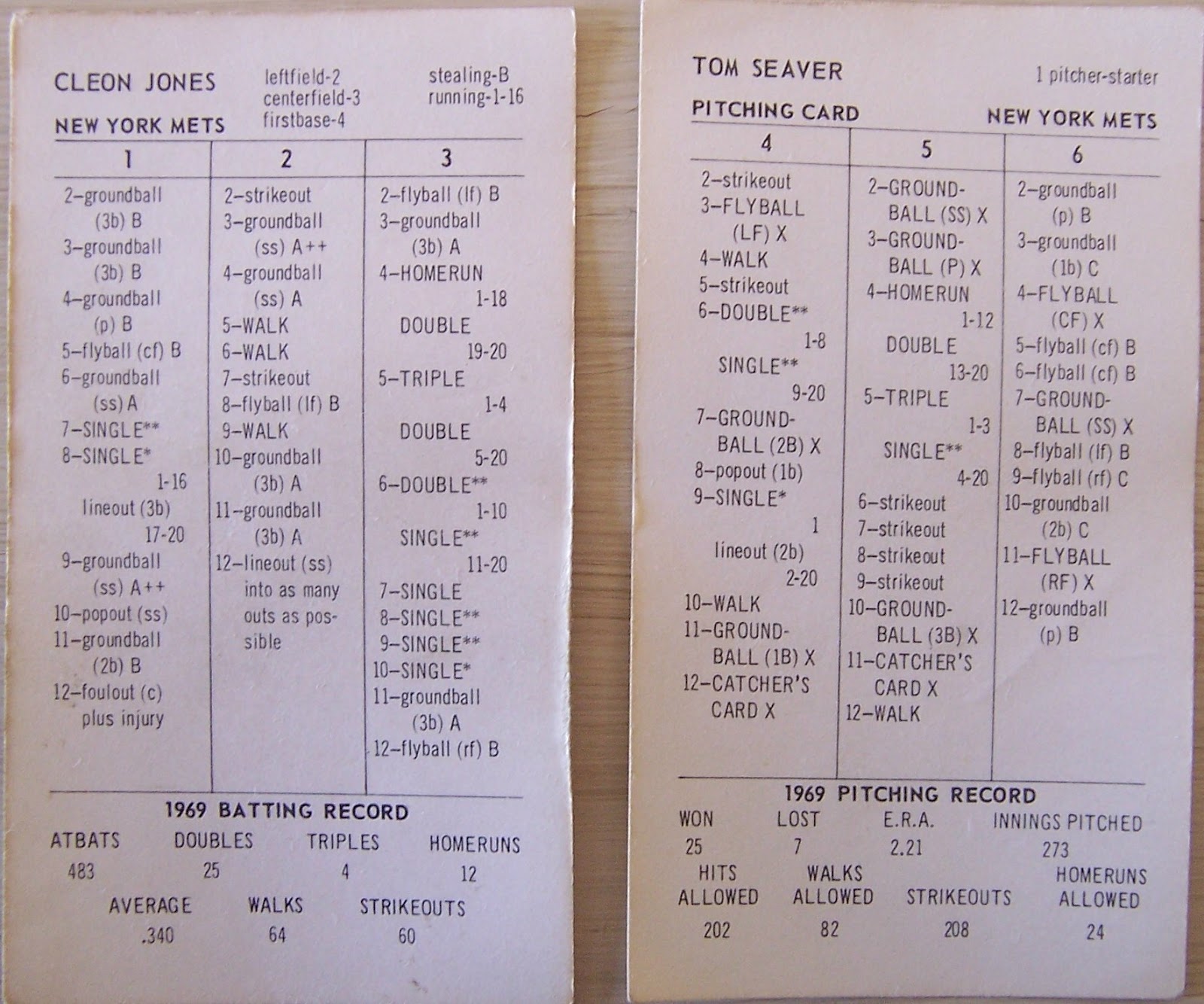
Before I get ahead of myself, however, some explanation may be in order for the un-initiated. Each season, Strat-O-Matic comes out with a new edition of player cards – one for each player on all of the major league teams. Each card contains the player’s name and shows the highlights of his previous seasons statistics – batting average, runs scored, doubles, triples, home runs, walks and strikeouts for hitters; wins, losses, earned run average, innings pitched, hits allowed, walks, strikeouts, and home runs allowed for pitchers. The beauty of the game is in its simplicity and realism, as each player performs reasonably close to their previous season’s performance; though as in life, some players will exceed expectations and others will disappoint.

The game is played with three dice – one red and two white die – which when rolled together determine the outcome of each at-bat. The red die determines whether to look on the batter’s card or the pitcher’s card, as columns 1, 2, and 3 refer to the hitter’s card, columns 4, 5, and 6 to the pitcher’s card. The total of the two white die determine where (from 2-12) to look within the column (nowadays there is a far more advanced computer version which essentially does the dice roll for you). So, if you roll a 1-7 (red die one, white die seven), you look to the hitter’s card in column 1, number 7 for the outcome of the at bat. If you roll a 4-6 (red die four, white die six), you refer to the pitcher’s card at column four, number six. The game plays quickly and easily, with a nine-inning game played in about 20-25 minutes. Each card contains its own personality, as a singles hitter like Matty Alou or Pete Rose might have a row of singles mixed in with a few walks scattered in other columns, while a power hitter like Willie Stargell, may have HOME RUN at 1-4, 1-5, and 1-6, followed by doubles and singles in the 1 column and a series of walks in the 3 column. A good pitcher’s card, however, like Tom Seaver’s 1969 card, could shut down a good offense with rows of outs in the 4, 5, and 6 columns.

The simplicity and personality of the player cards captured my imagination, but the ability to manage the team, choose the lineups for each game, decide who would leadoff and hit cleanup and which pitcher would start that day’s game, is what hooked me. I decided when to platoon a position player; when to steal, hit-and-run, bunt, and play the infield in; when to pinch hit for the pitcher, make a late inning defensive replacement, and intentionally walk an opposing batter.

Each player is rated individually for such things as base stealing ability, base running (i.e., the ability to go from first to third or second to home on a single, or first to home on a double), fielding, and bunting ability. Within a few years of my first edition, the game developed a more advanced version with lefty-righty breakdowns, outfielder’s and catcher’s throwing arms, pitcher’s endurance, and several other highly-refined statistical differentiations, including each fielder’s range and error rates (accounting for the fact that some players cover a lot of ground while also making a lot of errors, while other players may have less range but cleanly field everything they can reach), and hit-and-run ability.

All through middle school and high school, I painstakingly kept the box scores and accumulated the season’s statistics for each 162-game season of the Cardinals. I played the same schedule the real-life Cards played, though when I checked the box scores each morning in the local paper to see how the real Cardinals did the night before, I did so in part to anticipate how “my players” would do in next year’s Strat-O-Matic season.

I still have all of my hand-kept statistics of my Strat-O-Matic seasons in the 1970’s. In looking them over recently, I was reminded that, in my first season, the Cardinals went 104-58, led by the spectacular pitching of Bob Gibson (25-5, 2.05) and Steve Carlton (21-10, 2.12) and the hitting of Joe Torre (22 HR, 102 RBI, .302), Lou Brock (.291, 107 R, 69 SB) and Curt Flood (.311, 40 doubles, 25 SB). Despite this quite impressive performance, we lost the first round of the playoffs in five games to the Cincinnati Reds, losing the fifth and final game in 16 innings by a score of 7-6, when Johnny Bench knocked in Lee May for the winning run. In looking over the box score from that game, I am forced to re-live the agonizingly painful frustration I felt as we lost in the bottom of the 16th, despite having taken a 6-5 lead in the top of that inning. Though my recollection fails me, I would not be surprised if some dice were thrown and profanities uttered, a not uncommon occurrence in Strat-O-Matic households.

It is probably fair to say that I was obsessed with Strat-O-Matic and with baseball during that time in my life, an obsession I would occasionally revisit in later years, when Strat-O-Matic developed a computerized version of the game, maintaining all of its traditional charm while keeping any statistic imaginable at your beck and call. I remember countless days sitting in class or study hall writing out my next game’s lineup, analyzing my season’s statistics, examining the upcoming schedule in anticipation of the opposing pitchers and the availability of my bullpen. I assiduously calculated the player’s stats, usually updating my stat sheet every three games or so, pencil and eraser in hand, without the aid of a calculator. To this day, I am convinced that Strat-O-Matic is why I am good with numbers. I can still calculate batting averages (hits divided by at-bats) and earned run averages (earned runs multiplied by nine, divided by innings pitched) in my head. I am not sure of what use it is to anyone, but it is a point of pride nonetheless.

Playing Strat-O-Matic baseball also made me a smarter, more informed fan. For several years straight, I knew each team’s best starting pitchers, their power hitters and base stealers, their exceptional fielders, good bunters, and which catchers were tough to steal against. And long before Billy Beane and Moneyball, I learned the value of the walk; as the “manager” of a speedy, base stealing, non-home run hitting team like the Cardinals of the 1970’s, I particularly valued a hitter’s card with a lot of walks mixed in with hits, which leads to a high on-base percentage and opens up additional run opportunities. Indeed, Billy Beane himself, and several other big league general managers, honed their analytical skills playing Strat-O-Matic.

In subtle ways, Strat-O-Matic was a teacher of life lessons; some teams were better than others, some players more valuable than others. Injuries occurred and you might have to make due for 15 games without your .363 hitter, as happened to me in 1972 when Joe Torre rolled a 1-12 (lineout (ss) – injured) and I pulled a 20 out of the split-deck pile, which was a 15-game injury. It was a bad day, but I had to deal with it. In some ways it made me more connected to the real-life team, because they were always dealing with injuries and other setbacks. I thought, If they can handle it, then so can I. In Strat-O-Matic, as in baseball, one must make the most of the talents and limitations of the players you are provided and hope that a little luck will come your way – not much different than the 1973 Mets or the 2011 Cardinals.

Strat-O-Matic required me to manage a full season with players who were as good or bad as the players in real life. And the results were stunningly accurate. In my first season, Julian Javier, the Cardinals’ second baseman, who hit .282 with 28 doubles, 2 triples, and 10 home runs in the 1969 season, hit .282 with 28 doubles, 1 triple, and 11 home runs in my Strat-O-Matic season. Lou Brock’s Strat-O-Matic batting average of .291 in over 600 at bats was only seven points lower than his real life average of .298.

And yet, as statistically-accurate as the game is, it also allows for the possibility that, in any given season, a player will over-perform or under-perform. In 1971, for example, in my second Strat-O-Matic season (playing with the 1970-based player cards), I placed a little known spot starter named Chuck Taylor in my starting rotation. Taylor had started only seven games in the regular season, finishing 6-7 with a 3.12 ERA. Under my guidance and wise counsel, however, Taylor would be a 20-game winner, finishing the season with 261 innings pitched and a record of 20-7 with a 2.00 ERA, greatly outperforming his real-life stats. Naturally, I interpreted this to mean that I was a particularly good judge of talent, as I could tell from Taylor’s player card that he was a highly underrated pitcher. Despite a team ERA of 3.11 (Gibson had another great year at 22-8, 2.06), we finished 89-73 that year, failing to make the playoffs, in part due to an inability to score runs. Joe Torre led the entire team in home runs with 14. Lou Brock once again proved the realism of Strat-O-Matic, batting .305 with 32 doubles, 5 triples, and 12 home runs in 630 at bats, compared to his actual numbers of .304 with 29 doubles, 5 triples, and 13 home runs in 664 at bats. Don’t you just love this stuff!

Over the years I have found that Strat-O-Matic has a way of connecting people. Even today, when I get together with my best friends from high school, or my brother, another long-time Strat-O-Matic player, the conversation will at some point revert to recollections of our Strat-O-Matic days. Whenever I meet another present or past Strat player, an instant bond occurs. Several attorney friends of mine have confessed to playing Strat-O-Matic as a kid (the United States Attorney for the Eastern District of Pennsylvania happens to be a former Strat player), and many famous people in the world of baseball are self-confessed Strat-O-Matic fanatics. Jon Miller and Bob Costas, two of the best baseball broadcasters of my generation, were avid Strat-O-Matic players growing up in the 1960’s and 1970’s. “From my first roll of the dice [in 1963],” Miller told Glenn Guzzo in Strat-O-Matic Fanatics: The Unlikely Success Story of a Game that Became an American Passion (Acta Sports, 2005), “I was hooked on Strat-O-Matic. I was crazed.” As a kid, Miller did the play-by-play of all of his games, mimicking Vin Scully, Russ Hodges, and Jack Thompson. “A career has to start someplace,” he noted.

Keith Hernandez, who won an MVP award as the first baseman for the St. Louis Cardinals in 1979, and who is considered among the best defensive first basemen to ever play in the National League, was religiously devoted to Strat-O-Matic as a kid. When he was invited to his first spring training in 1974, upon arrival in Florida, he discovered that his Strat-O-Matic cards and game board were missing. Upset, he called his Dad, who simply laughed and said that he had taken it out of his luggage. “Just focus on what you have to do,” he advised. Hernandez, who now broadcasts games for the New York Mets, frequently makes Strat-O-Matic references on Mets broadcasts and insists that his knowledge of the game was forever enhanced by playing Strat-O-Matic baseball.

Many other Major League players also grew up playing Strat-O-Matic, and many make it a point to check out what their player cards look like each year. Ken Singleton, who accumulated over 2,000 hits in a very distinguished career with the Baltimore Orioles, once told Newsweek, “You know you’ve really made it as a ballplayer when you see a Strat-O-Matic card of yourself.” Former Phillies center fielder Doug Glanville, a University of Pennsylvania engineering graduate who now writes a column for The New York Times, once argued with Hal Richman about his defensive rating on his Strat-O-Matic card (he was consistently rated as a “2” defensively in center field which, while good, was not the “1” rating he naturally believed he deserved).

As a teenage boy growing up in central New Jersey, Strat-O-Matic, like baseball, was in my blood. Four decades later, as I think back on my Strat-O-Matic days, I am reminded of the innocence of youth, of the need to believe in something larger than oneself. To imagine, to dream that one day there would be a Strat-O-Matic card for me; to enter an imaginary universe that simulated reality, yet was connected to the real life game; and that allowed me to enter a world that most young boys can only dream of, a big league dugout in which I called the shots, judged the talent, had input into the outcome, and accepted responsibility for the results, win or lose. This, to me, is the beauty and power of Strat-O-Matic and why it will forever find a place in my heart.

Wednesday, February 29, 2012

A Call for Compassion

Our greatest threat is not the atomic bomb. Our greatest threat is the callousness to the suffering of man. – Rabbi Abraham Joshua Heschel
We live in a dangerously polarized world, full of division and hatred, suffering and violence. Conflict rages in places as diverse and far off as Afghanistan and the Middle East, Chechnya and the Sudan. Although the chief causes of these conflicts are political and territorial, they are cloaked in religious terms. The world’s major religions – I speak here of the monotheistic traditions of Judaism, Christianity, and Islam – have failed miserably at countervailing the forces of injustice. In many parts of the world, religious fundamentalists, including many self-proclaimed Christians in this country, have sowed the flames of prejudice and ignorance. Muslim extremists have used their faith to justify and commit atrocities that violate Islam’s most sacred values. The Arab-Israeli conflict has been allowed to fester for generations, turning a secular and political conflict into a “holy” war in which reasoned compromise and pragmatic solutions are victim to intransigence and intolerance.

Every day the news is filled with stories of tragedy and conflict; of school shootings, suicides, and murders; financial institutions in crisis; the growing and shameful gap between the richest and poorest among us. People have lost faith in the political process and have stopped talking and listening to each other. Many young people today are beset with feelings of alienation and helplessness, as the religious and secular institutions around them seem impotent, incapable of solving the world’s problems.

Even the quality of our political conversations has suffered. When I was in college and law school in the early 1980’s, I often argued with my Republican friends and other students about current events. We debated many of the same issues that today continue to divide liberals and conservatives, Democrats and Republicans – the government’s proper role in alleviating poverty and putting people to work; the need for social welfare programs; the pros and cons of government regulation. But even in the most heartfelt and animated discussions, there existed mutual respect and goodwill between us. It was understood that, though we disagreed on the means, we sought common ends; it was an accepted truth that each of us desired a peaceful and prosperous world. We struggled in different ways with issues of fairness and equality, productivity and individual responsibility, but we understood that our arguments were made in good faith. Sadly, in today’s environment, such civil discourse seems less possible.

Something is missing in American political life today. It has been festering like a sore for the past two decades or so, when compromise became a dirty word and the conversation turned bitter and ugly. Political disagreements are no longer principled differences, but instead reflect one’s integrity and worth as a human being. The cultural divide also has carried over into mainstream religious institutions, in debates over gay ordination and marriage, and in disputes over religious orthodoxy and biblical inerrancy. Lost in the political and religious culture wars is the concept of compassion.

In some circles, to speak of compassion is suspect, an indication that one is soft. For persons of power and influence, presidents and senators, civic and business leaders, speaking of a compassionate society suggests weakness. For most of us, in our everyday lives, compassion takes a back seat to cold realism. We do what we must to get through each day, to satisfy the demands of our jobs and of life’s competitive pressures.

Albert Einstein foresaw that as our society grew more modern and technologically advanced, we would need the virtues of our traditions more, not less. He described such tradition-based figures as Moses, Jesus, Buddha, and Gandhi, as “geniuses in the art of living – more necessary to the dignity, security and joy of humanity than the discoverers of objective knowledge.” In an age of atomic warfare, Einstein knew that the future of humanity demanded compassionate applications to the world’s problems, whether scientific, medical, economic, or political.

In November 2010, Krista Tippett, the host of NPR’s Speaking of Faith (now called On Being), lectured on compassion at a TED conference, rightly noting that compassion is a word of great meaning, one possessed of transformative powers. If properly understood, compassion has the power to change us, individually and collectively. Compassion is not, as is sometimes believed, sympathy or pity for the less fortunate. Rather, compassion consists of genuine expressions of kindness; of empathy for the sorrows and joys of others; of forgiveness and reconciliation, generosity and hospitality. Compassion is not a feeling or an emotion, but is physically manifested, and must be cultivated and practiced in everyday life. Compassion is curiosity without assumptions, a willingness to see beauty in others, including the child with Down’s syndrome, the mentally disabled man in a wheelchair, the toll collector, the police officer, the soldier; all of the strangers in our midst.

Compassion brings us into the territory of mystery and allows us to see the face of God in each other, in the members of our families, our friends, our co-workers; in the homeless women begging for change by the subway grate, and the drug addict huddled beneath the bridge. Compassion is tenderness.

One of the chief tests of our generation is whether we can build a global society that allows people of all religious and political persuasions to live together in peace and mutual respect. Where are the voices of compassion in the world today? The major faith traditions, which often are part of the problem, should be leading the way in helping to make a more just and compassionate world a reality. Historically and theologically, principles of compassion are embraced by all of the world’s religions. It is the essence of the Golden Rule, to do unto others as you would have others do unto you. Judaism teaches tikkun olam, to repair the world; Jesus teaches to love thy neighbor as thyself; and Mohammed instructs, “That which you want for yourself, seek for mankind.” And yet, too often the voices of religious extremists drown out the voices of compassion.

Whether in the public pronouncements of Christian and Islamic fundamentalists, the bishops of Rome, or the ultra-Orthodox Hasidim in the West Bank, lately one hears few appeals to compassion; instead, the focus tends to be on matters of sexual conduct or ancient doctrinal disputes, implying that a “correct” view of these issues are the true criterion of faith. “Man has often made a god out of dogma,” admonished Rabbi Abraham Joshua Heschel, “a graven image which he worshipped. . . He would rather believe in the dogma than in God . . . [and] be ready to take other people’s lives, if they refuse to share his tenets.”

It is difficult to think of a time when the compassionate voice of religion has been so needed. Krista Tippett has said that she once believed “that all of the important and interesting problems in the world were political, and all of the solutions, too. But I changed my mind.” She has since realized there “are places in human experience that politics cannot analyze or address, and they are among our raw, essential, heartbreaking, and life-giving realities.” The really important things in life, as in death, “how to love, how we can be of service to each other . . . are the kinds of questions religion arose to address.” Have our religious institutions lived up this challenge?

How do we restore compassion to the center of our civic and political life? How can we make it the essence of religion, morality, and civic virtue? Theologian and historian Karen Armstrong, author of The History of God: The 4,000-Year Quest of Judaism, Christianity, and Islam (Ballentine Books, 1993), and perhaps the world’s foremost expert on the history and traditions of the Abrahamic faiths, helped formulate the Charter for Compassion, an important and potentially transformative document drafted in November 2009 by the leading voices of six faith traditions (Judaism, Christianity, Islam, Hinduism, Buddhism, and Confucianism). The Charter, which affirms that compassion “lies at the heart of all religious, ethical and spiritual traditions,” calls upon people of all faiths “to return to the ancient principle that any interpretation of scripture that breeds violence, hatred or disdain is illegitimate; to ensure that youth are given accurate and respectful information about other traditions, religions and cultures; [and] to cultivate an informed empathy with the suffering of all human beings – even those regarded as enemies.”

Until we are able to see the humanity in each other, to set aside ego and transcend selfishness, to see the world through the eyes of the Other – the strangers among us, those with whom we disagree, our enemies and our friends; until we are able to feel empathy and seek genuine understanding, we are doomed to repeat the divisions and hatreds of the past. “There is no human being,” wrote Heschel, “who does not carry a treasure in his soul; a moment of insight, a memory of love, a dream of excellence, a call to worship.” True compassion breaks down the boundaries of politics, dogma, ideology, and religion. The practice of everyday compassion helps us recognize our interdependence and our shared humanity. “We can either emphasize those aspects of our traditions, religious or secular, that speak of hatred, exclusion, and suspicion,” says Karen Armstrong, “or work with those that stress the interdependence and equality of all human beings.” The choice belongs to each of us.

Sunday, February 12, 2012

A Matter of Perspective

When I was first married, my mother-in-law sat down at her kitchen table and told me about the day she went to confession and told the priest that she and her husband were using birth control. She had several young children, times were difficult – really, she could have produced a list of reasons longer than your arm.

“You’re no better than a whore on the street,” said the priest.

This was . . . a long time ago. It’s just an explanation of why the bishops are not the only Roman Catholics who are touchy about the issue of contraception. – Gail Collins, The New York Times (“Tales From the Kitchen Table”).
There is nothing like a culture war to get people’s juices flowing. Some of the rhetoric coming from the Republican presidential candidates this past week has been, to say the least, over the top. Newt Gingrich accused President Obama of waging a war on religion. Mitt Romney said the President was trying to “impose a secular vision on Americans who believe that they should not have their religious freedom taken away.” Rick Santorum, who is personally opposed to contraception, suggested that Obama was a step away from bringing the guillotine to America.

Relax guys. There is no war on religion. There will be no guillotines. There is no attack on the Catholic Church, or any church. President Obama is not anti-religion. As I have pointed out before on these pages (“The President on Prayer, Humility, and the Search for Wisdom” and “The Role of Faith in the Public Square”), Obama is a committed Christian who possesses a compassionate and refreshing Christian orientation that is far more Christian than anything I hear coming from the mouths of Gingrich and Santorum. Although the Republicans won’t pass up any chance to shout inflammatory rhetoric and accuse Obama of trampling on the rights of believing Christians, I am quite certain that Jesus of Nazareth would be far more comfortable with the President’s brand of religion than with the hypocritical Newt or repressive Rick.

Somehow lost in most of the discussions and finger pointing this past week are the facts. The HHS regulation at issue simply requires that preventive health care services, which must be covered by employer health insurance policies without co-pays under the Affordable Care Act, include contraception. It does not require anyone to use birth control. It specifically exempts churches and any religious employer that primarily hires and serves its own faithful. Although it applies to religiously affiliated hospitals and universities that serve the public and engage in interstate commerce, no Catholic hospital must itself provide contraception or family planning services to their employees or patients. They simply cannot opt out of insurance policies that cover the cost of birth control to their employees, but must in fact offer the minimum level of insurance coverage for preventive health services as do all other employers under the Affordable Care Act.

Much overlooked is the fact that Catholic hospitals have complied with similar rules concerning contraception coverage already in place in 28 states. It has been the law in New York state for the past ten years. Fordham University, a Jesuit college in the Bronx, has a health plan for its employees and students that cover contraception, though it does not distribute birth control at its student health center. Manhattan College, founded in 1853 by the De LaSalle Christian brothers, a Catholic religious order, carries an insurance policy that covers birth control prescriptions. Many other Catholic health care systems and universities provide similar coverage to their employees. Somehow, none of these state requirements have inflicted the slightest blow to the teachings of the Roman Catholic Church.

As Linda Greenhouse of The New York Times noted, the 629-hospital Catholic health care system, which employs 765,000 people, constitutes 14 percent of the entire U.S. health care industry and serves one out of every six patients. Of the top ten revenue producing hospitals in the United States in 2010, four were Catholic. Catholic Health Initiatives, for example, in Denver, Colorado, operates 78 hospitals in 20 states and has revenues of $8.2 billion a year. Catholic Healthcare West in San Francisco is the fifth largest hospital system in the United States, with over $11 billion in assets. Ascension Hospital in St. Louis, Missouri, runs 67 acute health care centers in 20 states and the District of Columbia. As Greenhouse writes, “These institutions, as well as Catholic universities – not seminaries, but colleges and universities whose doors are open to all – are full participants in the public square, receiving a steady stream of federal dollars. They assert – indeed, have earned – the right to the same benefits that flow to their secular peers. What they now claim is a right to special treatment” as a result of religious doctrine.

These hospitals and schools hire hundreds of thousands of Catholic and non-Catholic employees alike – nurses, doctors, teachers, administrators, secretaries, and janitors – all of whom are entitled under the Affordable Care Act to preventive health services, including contraception, without having to pay costly co-pays. So, what is all the fuss about? Is it a violation of religious freedom to require Catholic hospitals and universities to provide their employees with insurance policies that cover contraception?

Under the Constitution, the Catholic Church has the absolute right to preach that birth control is immoral. While I believe the Catholic Church’s position on contraception is archaic, inhumane, and has contributed historically to human suffering and poverty, particularly in poorer countries where the doctrine is more likely to be followed, I respect the right of the Church to preach its version of the Truth. But when an institution engages in commercial and secular activities, its mere affiliation with the Catholic church, or any other religious group, does not give it the right to exemptions from laws and regulations that apply to everyone else. Nor does a religious affiliation entitle a hospital or university from depriving its employees of their rights under the law as citizens.

A religious body that does not like a public policy that affects its members is free to advocate and work to change such policies. But it cannot claim a special exemption from the law. In the case of Catholics and contraception, how principled is the opposition? I cannot help but think a large part of what is going on is political spin and a loss of perspective. Yes, the Catholic Church officially teaches that contraception is a sin, but 98% of American Catholics have at one time or another violated that teaching. So, is it really a matter of conscience? Would these same voices support the right of a school run by Christian Scientists to deprive its teachers and janitors of a health care plan because they do not believe in medications, surgery, or medical intervention, and instead believe only in prayer as a way to heal? If a church is opposed to blood transfusions, are they entitled to remove this procedure from its university health plans for the employees who clean the labs and mow the campus lawn? If we were talking about a sincere religious prescription against antibiotics instead of contraception, would the same people arguing over the Affordable Care Act be coming to the defense of these religious institutions? I think not.

The Catholic Church does a lot of great work in this country, and throughout the world, in providing social services, health care, and aid to the poor, all consistent with its view of the Gospels, to care for all of God’s children. I disagree with the Catholic Church’s rigid position on abortion, but I have always respected its pro-life consistency in opposing abortion and capital punishment alike and advocating economic justice for children and the poor; they don’t abandon the children after they are born, but advocate for governmental aid for poor children, and work to assist poor families through the many good works of Catholic Charities and other church-based organizations. Complying with the Affordable Care Act and the HHS regulation, which as modified by the President later this week is endorsed by the Catholic Health Association and Catholic Charities, violates no one’s religious freedom.

Irrespective of the religious freedom issue, underlying much of the opposition from the right is a deep-seated hostility to the concept of birth control as preventive health care, as well as a belief that the government simply has no business in ensuring that American citizens have a right to basic health care services. Is contraception a legitimate health care issue? What business does the government have in making contraception affordable and accessible?

There are many compelling reasons why contraceptive services are properly included under the definition of preventive care, and it is, frankly, a shame and a disgrace that the Catholic Church, the Republican presidential candidates, and many Evangelical Christians who, while not agreeing with the Catholic Church on birth control, nevertheless see an opportunity to accuse Obama of being anti-religion, fail to acknowledge the positive impact contraception has had on the health of women. It is a matter supported by countless studies and painstaking research. For example, according to a January 2011 report submitted by the Guttmacher Institute to the Institute of Medicine, the health arm of the National Academy of Sciences, contraception is a crucial component of preventive health services for women, helping to avoid unintended pregnancies, reduce abortions, improve birth spacing, and increase the overall health of women and children. A national study in 2006, for example, found that nine million clients receiving publicly funded contraceptive services resulted in 1.94 million fewer unintended pregnancies and 810,000 fewer abortions. A 2007 study in California showed that publicly funded family planning services resulted in 287,000 fewer unintended pregnancies, including 79,000 to teenagers, and 118,200 fewer abortions.

The positive health benefits of contraceptive services extend well beyond merely preventing unintended pregnancies. Short birth intervals between pregnancies, which occur when contraception is not easily accessible or affordable, often lead to lower birth weights, preterm births, and small size for gestational age. Women who become pregnant without planning are less likely to recognize a pregnancy within the first six weeks or so, resulting in fewer prenatal care visits to doctors and more damaging behavior (alcohol and tobacco consumption, poor nutrition) during the early stages of pregnancy. Oral contraceptives have been shown to help women reduce the risk of developing endometrial and ovarian cancer and to provide short-term protection against colorectal cancer. Condom use among males prevents sexually transmitted diseases, including HIV, and may also reduce the risk of cervical cancer for women.

According to the Centers for Disease Control and Prevention (CDC), the development of and improved access to contraception are among the 10 great public health achievements of the 20th century, along with the development of smallpox and polio vaccines and public health campaigns to reduce tobacco use. Access to contraception has “contributed to the better health of infants, children, and women, and have improved the social and economic role of women.” Indeed, the use and coverage of contraceptive services as part of preventive health care services has been recommended by the American Medical Association, the American Academy of Family Physicians, the American Academy of Pediatrics, the American College of Obstetricians and Gynecologists, and the Society for Adolescent Health and Medicine.

Then why the need to provide contraception coverage free of costly co-pays? Because the costs associated with contraceptive use, while minimal for more affluent members of society, can be considerable for those of lesser means. Average costs for contraception, particularly women using the pill, and other devices, can exceed $100 a month. A 2010 study found that the out-of-pocket expenditures for a full year’s worth of birth control pills amounted to 29% of the average woman’s annual out-of-pocket expenditures for all health services.

Moreover, when it comes to reducing the overall costs to society of health care expenditures, contraceptive services are extremely cost effective. According to the Guttmacher Institute, every dollar invested by the government for contraception saves $3.74 in Medicaid expenditures for pregnancy-related care related to births from unintended pregnancies. This is a huge savings. In 2008 alone, the services provided at publicly funded family planning clinics saved over $5 billion in health care expenditures. Savings to health insurance companies and employer provided health insurance plans are equally dramatic.

None of this, of course, matters to those on the right who oppose the President on every action he takes, every policy he pronounces. When they see an opportunity to claim that “Obama is out to get your momma,” then by God, they are going to play that card. After the outcry from the Roman Catholic bishops and others, including Democratic allies in the Catholic community, the President revised the rule on birth control coverage so that religiously-affiliated hospitals and universities could shift the cost of contraception coverage to their insurance companies. Some on the left have criticized the President for caving to tyrannical bishops and right-wing zealots; many on the right are just as unhappy with the compromise as with the original regulation. So be it. Unlike his political opponents, Obama has proven once again that he is serious about governing, not political pandering; that he is willing to accommodate the concerns expressed by Catholic institutions while assuring universal access to contraceptive services.

There is no war on religion. The First Amendment remains an enduring and essential element of our constitutional democracy. The Catholic Church can continue to preach against contraception and its hospitals and universities will not be forced to provide contraception services. But the people who work for those institutions, and all other Americans, are entitled to an essential component of health care reform that is good for women’s health, reduces unintended pregnancies and abortions, and enhances the lives and health of millions of Americans. The only remaining question for conservatives is to what are you really opposed? Any principled “religious freedom” argument is gone. So, is it contraception you oppose? Affordable contraception? Access to affordable contraception? Expanded access to preventive health care services for all Americans? The rights of women? Or are you just cynically and politically motivated to oppose the President’s every move? What kind of religion is that?

Saturday, February 4, 2012

Why Poetry Matters

The world is too much with us: late and soon,
Getting and spending, we lay waste our powers:
Little we see in Nature is ours;
We have given our hearts away, a sordid boon!
This Sea that bares her bosom to the moon;
The winds that will be howling at all hours,
And are up-gathered now like sleeping flowers;
For this, for everything, we are out of tune;
It moves us not.

--William Wordsworth (“The World Is Too Much With Us”)

I have never been good at small talk. I sometimes experience physical pain at cocktail parties and so-called “networking” events, as I try to feign interest in what some self-important person has to say about yawn-inducing stuff that is destined not to matter or be remembered. I tend to talk very little at these events and try to leave early. When I am lucky, I find a kindred spirit, someone who shares my disdain for triviality, who believes that life is too short to ignore that which makes life worth living; someone who shares my passion for the world of ideas and would rather discuss religion and philosophy, history and politics, or something really important, like baseball. It is a rare moment, it seems, when serious conversations occur, when we genuinely reflect with each other on ideas and notions that touch the human spirit, or endeavor to address the world’s problems. “Carpe diem. Seize the day, boys. Make your lives extraordinary.” This inspirational statement, urged by the character of John Keating in Dead Poets Society, is why I write these essays. I do not always have the answers and sometimes have the wrong ones, but at least I ask the questions. It is my attempt, however feeble, to develop deeper insight into the diversity of life.

I do not suggest that we must always be serious. God only knows that we need a little more light-hearted humor in this world. Laughter, especially the gut-wrenching, roll-over-and-fall-down variety, is an essential human emotion that makes us feel alive. Sometimes we need a little more Rodney Dangerfield and a little less quantum physics. (Rodney Dangerfield grabs his necktie and jerks his head, his eyeballs popping out of his face. I don’t get no respect, no respect at all. The other day I went to see my psychiatrist and he told me I was crazy. I said, "I want a second opinion." He said, “You’re ugly, too!”). But, as Yogi Berra once said, “The future ain’t what it used to be. . . . It ain’t the heat, it’s the humility. . . . Nobody goes there anymore. It’s too crowded.”

Let’s face it, being human is a difficult and complex endeavor. We do what we must to earn a living, take care of our families, and meet our financial obligations. But we often forget or ignore the things that should demand more of our time and attention. When we engage with the beauty of our surroundings, explore the miracles of science and nature, and open our minds to great works of art, we more meaningfully connect with our humanity. It is why I so like baseball which, for me, like good drama and great literature, captures the emotions and passions of my youth.

It is easy to ignore the majesty of the world around us, to become caught up in our day-to-day struggle to master an ever more competitive world, the demands of work and the pressures of life. The world has a way of beating us down that, over time, causes us to appreciate less the intricacies of life and the wonders of nature; the red-wing blackbirds nesting in the oak tree bordering the fence in my backyard, or the playfulness of the squirrels climbing and jumping from tree-to-tree in search of food. It is not our ability to sell a new product or land a new contract that makes our lives meaningful. Instead, science and theology, poetry and the study of history, art and music, genuine human interaction, these are the ways we share in the great human quest for truth and understanding.

“Life is never made unbearable by circumstances,” Viktor Frankl wrote in Man’s Search for Meaning, “but only by lack of meaning and purpose.” Physicist and astronomer Adam Frank, who writes for National Public Radio’s Cosmos and Culture, asks, “When that eventual moment comes and we prepare to slough off this mortal coil, will we be able to look at our years on the planet and feel that we created real meaning for ourselves and those around us?” Frank suggests that being aware of the wonders of the universe, to the mysteries of science and the beauty of the natural world, are what help us to feel alive:

[T]he process of trying to honestly enter into a dialogue with the world establishes a context for my own life that sometimes allows me to rise above the petty day-to-day squabbles of broken washing machines and general knuckle-headedness. By entering into that dialogue with great effort and earnestness, the world ceases to be something merely “at hand,” something merely there for distraction or entertainment.

Instead, it’s fully alive and present. The ever-opening sky, the wheeling stars and even the nightly stream of crows I watch heading to their evening roosts all become poignant mysteries that speak of greater powers than I will ever fully understand.
Like many professional people of my generation, my work and career are important to me. It is, after all, how I spend the majority of my waking hours. But as the years progress, I am less tolerant of competitive, ambitious, get-out-of-my-way people, interested only in self-aggrandizement, the size of their bonus, and landing the next big contract. I have observed clients, former classmates and colleagues work 70 to 80 hours a week for companies and firms that produce nothing of value. Sales targets, quotas, revenue origination, become the measured worth of the individual. The world of ideas, of passion and poetry, is something for which many have little time or interest.

“Being human is never easy,” writes Umair Haque, a refreshingly innovative thinker who authors a blog for the Harvard Business Review. “Perhaps as an unintended consequence of our relentless quest for more, bigger, faster, cheaper, now, we’ve comfortably acceded to something akin to a minor-league contempt for the richness and grandeur of life unquenchably meaningfully well lived.” Technological advancements have made the U.S. workforce 25 times more productive than it was 100 years ago. And yet, more and more jobs are moved offshore as companies hoard record profits; in the process, we seem to have produced a shortage of, in Haque’s words, “living, breathing, well-rounded humans; with a moral compass, an ethical core, a cosmopolitan sensibility, and a long view born of historicism. What we’ve got plenty of are wannabe-bankers whose idea of a good life goes about as far as grabbing for the nearest, biggest bonus – what we’ve got less of are well-rounded people with the courage, wisdom, and capacities to nurture and sustain a society, polity, and economy that blossom.” We need more people who can master the art of “nuance, subtlety, humility, and grace.”

Perhaps we need more poetry and less measuring sticks, more reflection and less cold, calculating reaction. Our politics have become mean-spirited, lie-induced, nightly responses to an increasing alienation infecting the populace. Our businesses and corporations have become impersonal, button-pushing, computer voice-overs that sacrifice human beings to save three cents on the dollar or to earn an extra 0.5% return on investment. Poetry, like literature, art, and music, provides “a language adequate to our experience,” explains poet and writer Jay Parini, author of Why Poetry Matters (Yale University Press, 2009). “It teaches us how to live our lives, how to locate and describe the inner life. . . . enhances our sense of the spiritual world by attaching us closely—almost physically—to the material world. . . . [and] refreshes our lives by refreshing our sense of language, making reality visible in unique ways.” Without poetry, Langston Hughes may never have written, “My soul has grown deep like the rivers.”

Poetry helps us to clarify and make sense of things, to see things in a more perfect light. Hopkins described poetry as “common language heightened,” for it refines the language of ordinary life. To ignore the power of poetry is to be indifferent to all of the things that make life worthwhile. “Poetry is finer and more philosophical than history,” said Aristotle, “for poetry expresses the universal, and history only the particular.”

I realize that poetry doesn’t matter to most people. Admittedly, I am neither a poet nor a student of poetry. But I understand its importance, even if I don’t practice its art. Perhaps if we paid closer attention to the poets, we would have less tolerance for war, torture, and human depravity. “To have good sense,” wrote Horace, “is the first principle of writing well.” When I see my youngest daughter write poetry as a means of making sense of a chaotic world, and of expressing herself in ways and on topics she otherwise refrains from discussing, I see firsthand its power to transform. Poets, like writers of great literature and composers of powerful and emotionally compelling music, give us context, language and meaning. Poetry has the power to open minds and alter lives. In a world without poetry, we would cease to be fully conscious of the possibilities that life affords.

Ultimately, poetry, like science, theology, art, and philosophy, is a quest for understanding, a striving for excellence. By reaching for a higher plane and challenging our assumptions, we remain attentive and awake to the everyday miracle of our existence. “Let us remember,” said Christian Wiman of Poetry magazine, “that in the end we go to poetry for one reason, so that we might more fully inhabit our lives and the world in which we live them, and that if we more fully inhabit these things, we might be less apt to destroy both.”

Tuesday, January 24, 2012

Caught in the Middle: Women's Rights and Coming of Age in the Seventies

Men weren’t really the enemy, they were fellow victims suffering from an outmoded masculine mystique that made them feel unnecessarily inadequate when there were no bears to kill. – Betty Friedan.
I was born in 1959, when Eisenhower was President and men wore business suits to baseball games. The civil rights movement was still in its infancy, Americans had yet to conquer the moon and Vietnam was a distant, far-off country that few people had heard of. The Cold War was in full bloom, the threat of nuclear annihilation hovered like a dark cloud above, and men ruled the world.

John Kennedy was elected President in 1960, in the Age of Camelot. With a young, handsome President and his glamorous wife on the cover of Life magazine, America was filled with optimism and youthful energy. Sophisticated and regal, Kennedy was, like his predecessors, surrounded almost entirely by men, the Best and the Brightest they would later be called, men who had been educated at Harvard and Yale, Andover and Choate, who promised to “pay any price [and] bear any burden . . . to assure the survival and the success of liberty.” They possessed an upbeat, optimistic view of the world and of America’s place in it. Although it all ended a few years later at the hands of a lone assassin, it remained a man’s world.

Kennedy’s men, and later Johnson’s and Nixon’s men, would embroil us in a difficult, messy, unjust war and struggle to make sense of changing times, but as a young boy growing up in suburban New Jersey, it seemed perfectly natural that men made the decisions and held positions of power and influence. Virtually all of my role models, the persons I wished to emulate, whether politicians, ballplayers, musicians, or actors, were men.

For the first decade or so of my life, American society had clearly defined roles for the sexes, or so it seemed. Boys were expected to pursue careers in law and medicine, run our companies, make our laws and, when necessary, fight our wars. Girls were expected to get married, have children, and provide emotional support for their families. It was almost that simple. Men were CEOs, Senators and Presidents, doctors, scientists and lawyers. We ran the corporations, the banks, the universities, and the government. Women labored in service-oriented and subservient positions, as nurses, teachers, librarians, and secretaries. The status of women, as explained in Woman in Sexist Society: Studies in Power and Powerlessness (New York: Basic Books, 1971), was “the result of a slowly formed, deeply entrenched, extraordinarily pervasive cultural (and therefore political) decision that . . . woman shall remain a person defined not by the struggling development of her brain or her will or her spirit, but rather by her childbearing properties and her status as companion to men who make, and do, and rule the earth.”

By the time I entered high school in 1974, the Supreme Court had ruled for 100 years that the Equal Protection Clause of the Fourteenth Amendment did not apply to women, who only a half century before had earned the right to vote. Indeed, women were confined to second-class citizenship in most aspects of law and economic life. And while a growing percentage of young women attended college, it was a common refrain even in the mid-1970’s said only partially in jest, that most girls went to college for their “MRS” degrees.

I grew up when Leave It to Beaver and Father Knows Best filled the screens of American televisions, part of a powerful socialization process reinforced by churches and schools, textbooks and the mass media. Before the advent of Title IX, society encouraged boys to play sports and girls to be spectators and cheerleaders. We were bombarded from infancy with portrayals of stereotypical sex roles, with advertising images of women as housekeepers and mothers, happily folding the laundry and cooking dinner in service to husbands attending to more pressing matters.

And then everything changed.

In 1963, Betty Friedan, a suburban housewife who supplemented her husband’s income by writing freelance articles for women’s magazines, published The Feminine Mystique. Several years earlier, Friedan had surveyed her Smith College classmates at their 15-year reunion and found that this highly educated and talented group of women, mostly housewives in their mid-30’s, were deeply dissatisfied with the state of their lives. From these and other interviews, and drawing on history, psychology, sociology and economics, Friedan wrote what would become one of the most influential books of the 20th Century. The Feminine Mystique described Friedan’s insights into the soul-draining frustrations of educated, stay-at-home women in the 1950’s. She called it “the problem that has no name”:

The problem lay buried, unspoken, for many years in the minds of American women. It was a strange stirring, a sense of dissatisfaction, a yearning that women suffered in the middle of the twentieth century in the United States. Each suburban wife struggled with it alone. As she made the beds, shopped for groceries, matched slipcover material, ate peanut butter sandwiches with her children, chauffeured Cub Scouts and Brownies, lay beside her husband at night – she was afraid to ask even of herself the silent question – “Is this all?”
The Feminine Mystique shocked middle class America and became an instant bestseller. It exposed the myth of the happy housewife, an ideal promoted by television, Hollywood, and mass advertising, and helped transform the expectations and roles of American women virtually overnight. With Friedan, Gloria Steinem, Bella Abzug and others leading the way, the women’s rights movement pushed for equal pay for equal work, gender-neutral help-wanted ads, maternity leave, child-care centers for working parents, legalized abortion, safe and accessible birth control, laws prohibiting sex discrimination in the workplace, and other issues often deemed radical by the standards of the early 1960’s.

I witnessed first-hand the growing consciousness and political empowerment of women in the late 1960’s and 1970’s. However little I may have paid attention to these issues in my younger years, intellectually and rationally, I understood exactly what women were demanding and why, for I wanted the same opportunities for myself. Black Americans and other minorities were properly demanding equal rights in all spheres of American life, so it was only appropriate that women would want these same things. The women I went to school with were just as bright and hardworking as me, so why should they not also be entitled to the same opportunities?

There were times, of course, when I reverted back to socialized sexism, when my competitive instincts and male role models did not easily reconcile to an imagined society in which the sexes were completely equal. I wanted to be respected and admired as a man of importance. I wanted to accomplish big things and be looked upon as someone special. Like any red-blooded American male, I wanted to slay the dragons and be greeted by admiring females. I wanted the women in my life to look at me with pride and affection as I battled the forces of evil and saved the world from destruction. I wanted to be Superman carrying Lois Lane to safety.

But then the rules changed. All of a sudden, women my own age and education level wanted a chance to slay their own dragons and hunt their own prey. They wanted to be Superwoman and didn’t need no stinking Superman. Men were no longer entitled to instant respect. We now had to compete not only with each other, but with women as well.

Had you asked me in high school if I was a feminist, I may have answered, “Sure, I dig chicks.” But I’m a fast learner. By the time I graduated college and entered law school, where I studied alongside lots of really smart, ambitious women who made up nearly half of my law school class, I genuinely embraced and acknowledged the merits of true women’s equality. My female classmates wanted the same opportunities as my male classmates – an interesting and satisfying career. And just like the men, the women saw no reason why they couldn’t or shouldn’t be able to combine a good career with a family.

Of course, American society was divided on the merits of a woman trying to do too much. “What about the children?” was a common refrain. Some contended it selfish and foolhardy for a woman to think she could do what needed to be done to advance in a pressure-filled, demanding legal career and still have time to raise a family. Men were not, were never, in my experience, asked these same questions. And yet, since the industrial revolution, a large percentage of men had failed miserably in mixing ambition with fatherhood. My female classmates understood this, which is why they wanted husbands who bore a greater share of responsibility for child rearing and house chores, who understood instinctively that an even distribution of responsibilities was only fair and just.

In all of my professional life since, I have worked for and beside many bright, talented women. It has always seemed quite natural, as if a continuation of college and law school, when women coexisted as equal partners in education. I have watched many of my female colleagues negotiate the constant struggle of balancing the demands of children with the desire to excel in their careers. When I first joined a large law firm in Washington, D.C., in 1986, a strong push was then being made for fair-minded and liberal family leave policies. It was debated regularly in offices and conference rooms of law firms and corporations, as employers sought to find ways to attract and retain highly qualified women professionals, and to provide the appearance of a family-friendly work environment. But inevitably, stories rolled-in about those who actually took advantage of these policies, who took time off to spend with their newborn infants and paid a price in stifled advancement and delayed career gratification. It could be no other way, really, the economic realities what they are in corporate America. There was still a long way to go.

Many of my friends and spouses, often two career couples, found the demands of toddlers and child care to be equally draining. The frustrations expressed by 1950’s housewives and Betty Friedan’s Smith College classmates were replaced by the frustrations of women (and some men) who, wishing to have it all, found that it was not so easy, that choices and sacrifices inevitably had to be made. Although the opportunities available to women have greatly expanded since The Feminine Mystique was first published, many women discovered that happiness can be elusive, whether pursuing a rewarding career or choosing the undervalued and underappreciated role of housewife and mother, or something in between.

Twenty-six years later, I wonder how many of my classmates have been disappointed with their careers and choices. How many underestimated the deep-seated socialization process that embedded traditional notions of home life in men, even those who seemed to be more progressive minded than most? How many had hoped that corporate America would more quickly adapt family friendly work environments?

The world is today more complex, if not necessarily more advanced. Advertisers and women’s magazines continue to portray the ideal Superwoman as super-thin and sexy, as someone who can wear a size 4 dress and flaunt a Barbie-doll figure while negotiating a merger and spying on the Russians. Pick up any issue of Cosmopolitan magazine and you will see nothing but photographs and articles on fashion, sex, make-up, weight loss, and tips on how to please a man. Meanwhile, American women and girls continue to face a body image crisis, with constant attacks on women’s self-esteem and self-worth. Women today are supposed to want it all, and when life comes up a bit short, when their careers or family lives, or both, do not match the glamorous images of the mainstream media, a crisis of confidence creeps into the mindset of many professional women. Women are now expected to have a career, many by necessity require financial independence, and yet they continue to bear the lion’s share of child rearing and housekeeping responsibilities.

In many ways, the advances made by women in the professions have been both a curse and a blessing to them. Despite the ever present glass ceiling, some women have successfully competed with men for the highest positions in business, law, medicine, and government. Those willing to sacrifice a rich family life, or cherished time with children – the same sacrifices ambitious men have been making for a century – can advance to positions of power and influence. And yet, for many women, a lingering dissatisfaction remains, the reality that merely emulating the life of a high-charging, career-driven man comes with many spiritual and emotional sacrifices, which even for a growing proportion of men, is not worth the cost of lost time with children and families.

Although I have occasionally looked with envy on the societal privileges (white) men enjoyed prior to the sexual revolution and The Feminine Mystique, I am today a better person, a better father, and a better co-worker because of the women’s rights movement. American society has made strides in the right direction. The big law firms, prestigious universities, and some major corporations today offer extended family leave plans, in-house child care options, and flexible work schedules. For my two daughters, I very much desire a world that provides women with the same opportunities and career options as men, that treats men and women with an equal degree of respect, and which allows everyone to pursue their dreams in ways that best fit their talents and skills. But I also hope that my daughters, and all young men and women, recognize that ambition has consequences, and that the dreamed-of career may not alone provide a fulfilling life; that it is important to explore what it means to live fully and passionately, with a sense of purpose and humility, authenticity and simplicity, and to drop preconceived ideas of who and what we are. "Our lives are a mixture of different roles,” said Hillary Rodham Clinton. “Most of us are doing the best we can to find whatever the right balance is . . . For me, that balance is family, work, and service."

The women’s movement will have succeeded if, as a society, we steadily seek a more compassionate and humane world that permits women and men to balance their lives in ways that are good for everyone; that allows us to enrich our spiritual and creative lives, to see the potential in ourselves and in others. For as Greta Crosby advised, “If I could give you one key, and one key only, to a more abundant life, I would give you a sense of your own worth, an unshakeable sense of your own dignity as one grounded in the source of the cosmic dance, as one who plays a unique part in the unfolding of the story of the world.”

Most Popular Posts in the Last Year